Search conditions, treatments, research reviews and articles. Press Enter to see all results, Esc to close.
Search conditions, treatments, research reviews and articles. Press Enter to see all results, Esc to close.
Blog
October 31, 2026
Thyroid eye disease (TED), also called Graves eye disease, is an autoimmune condition. It inflames the muscles and fatty tissue around the eyes. This can cause gritty, red or puffy eyes, bulging eyes and double vision. Most cases are mild, but some threaten sight and need urgent treatment [1,2].
This article is general education, not a diagnosis. Faded colors, dimmer vision, a new gap in your vision or a painful eye that cannot close need same-day care. See an eye doctor or go to an emergency department.
Key takeaways
In this article
Get same-day care if you notice vision loss, colors that look faded or washed out, a new gap in your side vision, or an exposed eye that is painful or has a white spot. These can mean the optic nerve is being squeezed or the cornea is breaking down. Both can cause lasting vision loss [1,2].
If you take teprotumumab or veligrotug, call the prescriber promptly about new hearing problems or signs of very high blood sugar [5,6]. With teprotumumab, also report new confusion [5]. With satralizumab, get help for signs of infection or a serious allergic reaction [16]. Netra's guide to urgent vision changes explains where to go.
Thyroid eye disease is an autoimmune disease that targets the tissue around the eyes. The eye muscles and fat swell inside the bony eye socket (orbit). This can push the eyes forward, pull the lids open and limit eye movement. It is most common in people with an overactive thyroid caused by Graves disease [1,2].
Other names include Graves eye disease, Graves orbitopathy and Graves ophthalmopathy. Almost everyone with TED has thyroid-stimulating hormone (TSH) receptor antibodies in the blood [2]. TED can rarely occur in people with normal or low thyroid levels, including people with Hashimoto thyroiditis [1,2].
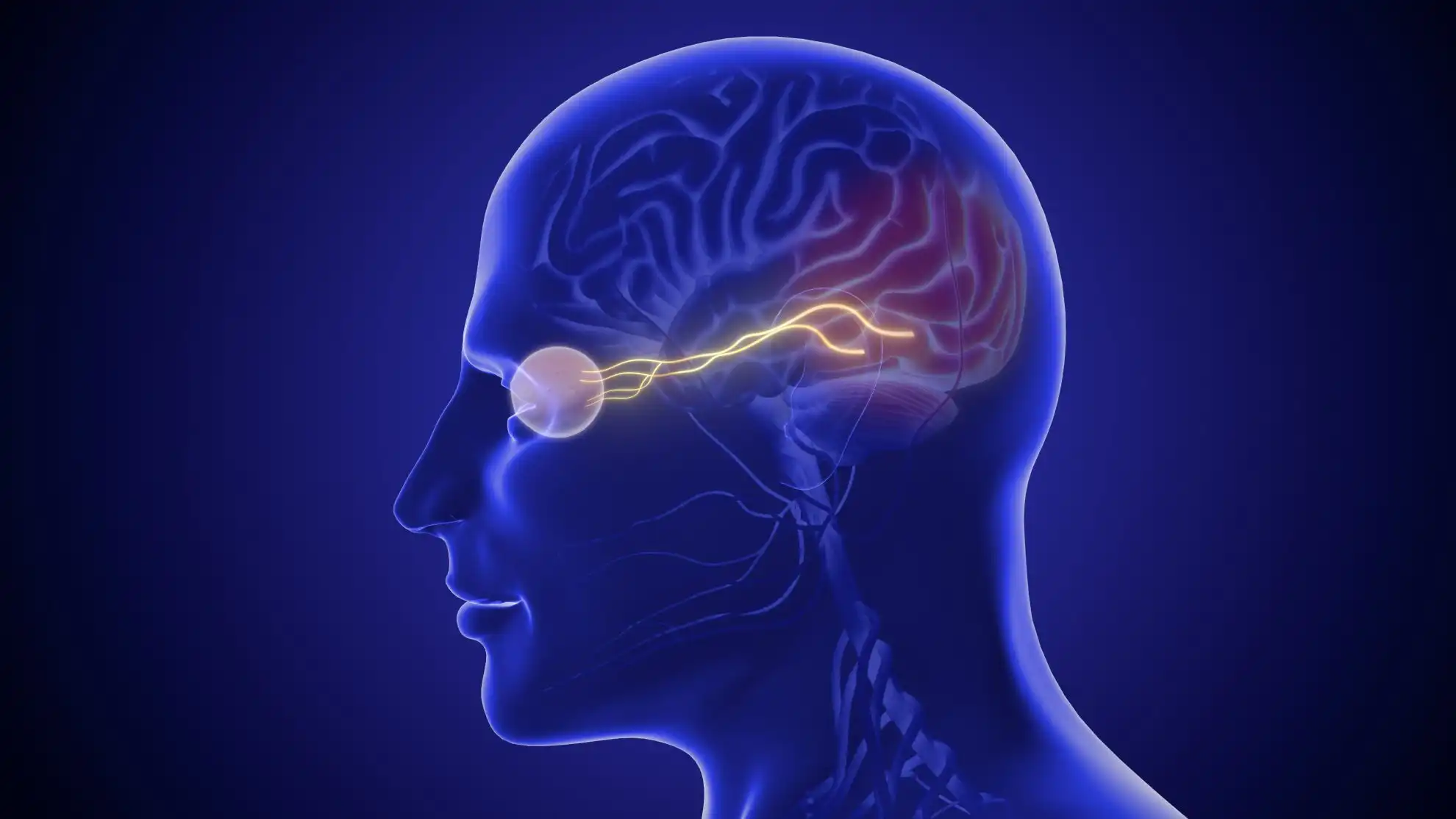
The orbit is made of bone, so swollen tissue has nowhere to go. At the back of the orbit, it can crowd and squeeze the optic nerve. At the front, a bulging eye or a raised lid may not close fully, which leaves the cornea dry and exposed [1,2]. How the eyes look does not show whether the optic nerve is safe. Tests of vision, color vision and side vision do [1,2].

About 1 in 3 people with Graves disease develop eye symptoms [1]. Moderate-to-severe TED affects about 6% of people with Graves disease, and sight-threatening TED about 0.5% [2].
Early TED often looks like dry eye or allergies. Common first signs are gritty or burning eyes, watering, light sensitivity, red eyes and puffy lids. Others include a staring look, pain behind the eyes or with eye movement, bulging eyes and double vision. Symptoms usually start within the first year after Graves disease is diagnosed [1].
Symptoms of thyroid eye disease include [1]:
Watery eyes can be a sign of exposure. When a raised lid does not close fully, the eye dries and makes extra tears [1]. Some people first notice that one eye looks larger in photos. Others see double only when looking in certain directions. Old photos can show your usual lid height. Netra's guides to pressure behind the eyes and light sensitivity cover other causes of these symptoms.
TED is caused by an autoimmune reaction against tissue in the eye socket, usually alongside antibodies to the TSH receptor. People with Graves disease have the highest risk. Smoking, thyroid levels that are too high or too low, and radioactive iodine treatment make TED more likely to start or get worse [1,2].
Some risk factors can be changed. You can stop smoking, avoid secondhand smoke and work with your doctor to keep thyroid levels in the normal range [1].
TED has two main phases. In the active phase, inflammation is changing, with pain, redness and swelling. In the inactive phase, inflammation has settled, but bulging, double vision or lid changes may remain. Many people reach the inactive phase about 12 to 18 months after the disease starts [2].
| Feature | Active TED | Inactive TED |
|---|---|---|
| What is happening | Inflammation is ongoing and signs can change | Inflammation has settled and findings are stable |
| Typical signs | Pain around or behind the eyes, red eyes and lids, lid swelling, changing bulging or double vision | Little pain or redness; bulging, lid retraction or double vision may remain |
| Timing | Starts at onset and usually lasts months | Usually reached about 12 to 18 months after onset [2] |
| Main goals | Calm inflammation and protect the cornea and optic nerve | Restore comfort, alignment and appearance |
| Common treatments | Lubricants, selenium for some mild cases, IV steroids, targeted medicines [2] | Prisms, orbital decompression, eye muscle surgery, eyelid surgery [1,2]; teprotumumab and veligrotug are also approved for inactive disease [5,6] |
Doctors often track activity with a 7-point Clinical Activity Score. A score of 3 or more usually means active disease [2]. Activity is followed over several visits, because one score can miss a change.
Severity is a separate question. It describes how much TED affects vision, the cornea, eye alignment, appearance and daily life. Doctors group TED as mild, moderate-to-severe or sight-threatening, and they record activity and severity separately [2].
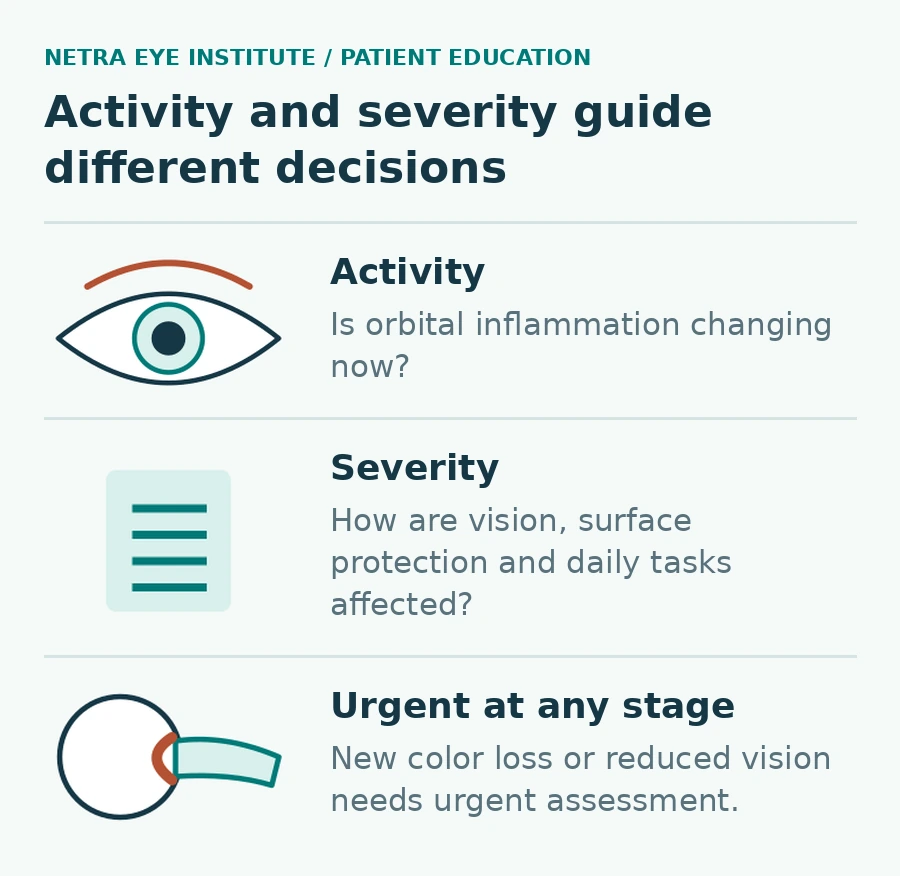
Sight-threatening problems can occur in either phase. Faded colors or vision loss need urgent care, whatever stage you were told you are in.
TED is diagnosed from your symptoms, an eye exam and thyroid blood tests. The eye doctor measures eye bulging, lid position, eye movement, vision, color vision and side vision. A CT or MRI scan of the eye sockets may be needed, especially if one eye is much more affected than the other [1,2].
Blood tests check thyroid hormone levels. TSH receptor antibodies are present in almost all people with TED [2]. Your primary care doctor, endocrinologist or eye doctor can make the diagnosis. You should be referred to an ophthalmologist if TED is moderate-to-severe or the diagnosis is unclear [1].
Imaging helps rule out other causes when TED is one-sided or unusual. It can also show crowding near the optic nerve and help plan surgery [2].
Bring a list of thyroid tests and treatments with dates, a timeline of eye symptoms, and all medicines and supplements. Mention smoking, pregnancy plans and any hearing problems, since these can change which treatment is safest [5].
Treatment depends on how active and how severe TED is. Mild TED is often managed with lubricating drops, sunglasses and prisms, plus selenium in some cases. Moderate-to-severe active TED may need IV steroids or a targeted medicine. Surgery is usually done once the disease is stable, except in emergencies [1,2].
These steps ease symptoms and protect the eye, but they do not switch off the inflammation [1,2]:
In a European trial of 159 people with mild TED, selenium taken as 100 micrograms twice a day for 6 months helped. It improved quality of life and slowed progression compared with placebo [10]. The ATA and European Thyroid Association say one 6-month course may be considered for mild, active TED, especially where selenium intake is low. They found no evidence of benefit in moderate-to-severe TED [2].
Most people in the United States get enough selenium from food, so the benefit for US patients is less certain. The upper limit for adults is 400 micrograms a day from all sources, and too much can cause hair loss and brittle nails [11]. Ask your doctor before starting it, and never use it in place of thyroid treatment.
For moderate-to-severe active TED where inflammation is the main problem, steroids given by IV infusion are a preferred treatment [2]. Other immune-modifying drugs or orbital radiotherapy may be used in selected cases [2]. These treatments work best early in the disease, ideally within the first 6 to 9 months [2].
As of October 2026, three medicines have FDA approval for TED. Teprotumumab and veligrotug are approved for TED regardless of how active it is or how long it has lasted [5,6]. Satralizumab was approved for adults with TED in October 2026 [7].
| Medicine | How it is given | How it works | Key label warnings |
|---|---|---|---|
| Teprotumumab (Tepezza) | IV infusion every 3 weeks, 8 infusions | Blocks the IGF-1 receptor | Infusion reactions; new or worse inflammatory bowel disease (IBD); high blood sugar; hearing loss that may be permanent; encephalopathy; avoid in pregnancy [5] |
| Veligrotug (Lumvoa) | IV infusion every 3 weeks, 5 infusions | Blocks the IGF-1 receptor | Infusion reactions; IBD; high blood sugar; hearing loss that may be permanent; avoid in pregnancy [6] |
| Satralizumab (Enspryng), adults | Injection under the skin; after the starting doses, every 4 weeks; can be given at home by the patient or a caregiver after training [7] | Blocks the interleukin-6 receptor | Serious infections; hepatitis B and tuberculosis screening first; liver and white blood cell monitoring; allergic reactions [16] |
In the main teprotumumab trial in active TED, 83% of treated patients had at least 2 mm less bulging at 24 weeks, compared with 10% on placebo. Among patients with double vision, it improved in 68% versus 29% [12]. For satralizumab, one of two trials met its main goal: in the trial that succeeded, 52.9% of treated patients had at least 2 mm less bulging at 24 weeks, compared with 23.4% on placebo [7].
The teprotumumab label asks for hearing checks before, during and after treatment. In early trials, about 1 in 10 patients had high blood sugar, most of whom already had diabetes or prediabetes. Blood sugar should be controlled before treatment and watched during it. People who could become pregnant should use contraception from before the first dose until 6 months after the last [5]. A warning about encephalopathy, a disturbance of brain function, was added in 2026 [5].
Rehabilitative surgery is usually done when TED is inactive [1,2]. When more than one operation is needed, the usual order is orbital decompression first, then eye muscle (strabismus) surgery, then eyelid surgery [2]. Decompression removes bone, and sometimes fat, to make room in the socket. It can cause new double vision [1]. Urgent decompression may be needed if a squeezed optic nerve does not respond to steroids [1,2].
Smoking is a major TED risk factor you can change. Smokers are more likely to develop TED, tend to have more severe disease and respond less well to treatment. Radioactive iodine for an overactive thyroid can trigger or worsen TED, especially in smokers. A short course of steroids can often prevent this [3,4,13].
In a Dutch study, smokers had about 7.7 times the odds of Graves eye disease compared with nonsmokers, and more severe eye disease [3]. In an Italian study of severe TED, 94% of nonsmokers responded to steroids and orbital radiotherapy, compared with 68% of smokers [4].
Quitting still helps. In a German study, current smoking, not lifetime smoking, raised the risk of bulging and double vision. Former smokers had a lower risk than current smokers [14]. Avoid secondhand smoke too [1,2]. Read more in Netra's guide to tobacco smoke and eye health.
In a large trial, eye disease appeared or worsened in 15% of people within 2 to 6 months after radioactive iodine. It was often temporary, and a 3-month course of prednisone prevented it [13]. A later trial found the highest risk in smokers [15]. Doctors usually avoid radioactive iodine if eye symptoms are moderate or severe [1]. Do not stop thyroid medicine on your own. Ask your endocrine and eye doctors to decide together.
There is no single cure, but TED usually settles. The active phase burns out, and many people reach a stable phase within about 12 to 18 months. Treatment can calm inflammation and protect vision. Bulging, double vision or lid changes that remain can often be improved with surgery once the disease is stable [1,2].
Most TED is mild and gets better over time [1]. But bulging and eye muscle problems often do not return to normal without treatment [2]. Keep up eye follow-up even when thyroid blood tests are normal.
No. Netra Restoration Therapy (NRT) does not treat TED and has not been tested in controlled trials for it. There is no evidence that it calms orbital inflammation, shrinks swollen tissue or protects the optic nerve. It does not replace medical or surgical care. Netra offers NRT only as adjunctive care alongside your endocrinologist and eye doctor.
Some people with stable, inactive TED still have comfort problems, such as burning or light sensitivity, after their eye doctor's plan is in place. They may ask about NRT as supportive care, with a specific goal tracked separately from eye measurements. You can read how Netra reports program outcomes by diagnosis.
Yes. Thyroid eye disease, Graves eye disease and Graves orbitopathy are names for the same autoimmune condition [2]. It is most common in people with Graves disease. It can rarely occur in people with normal or low thyroid levels [1].
Not always. Keeping thyroid levels in range helps, because high or low levels can make TED worse [1]. But bulging and eye muscle changes often do not return to normal on their own [2]. Keep having eye checks even when your blood tests are normal.
The active phase usually lasts months, and many people reach a stable phase about 12 to 18 months after onset [2]. Some changes, such as bulging or double vision, can remain after that. Timing varies, so your eye doctor tracks activity over repeated visits.
Yes. TED can affect one eye more than the other, or appear in just one eye. When TED looks one-sided or very uneven, doctors usually order a CT or MRI scan to rule out other causes [2]. Grading is based on the more affected eye.
Raising the head of your bed or sleeping on extra pillows can ease puffiness [1,2]. Lubricating drops and wraparound sunglasses help with comfort [1]. Swelling from active inflammation may need prescription treatment, such as steroids. Ask your eye doctor if swelling is getting worse.
The most common side effects of teprotumumab (Tepezza) include muscle spasms, nausea, hair loss, diarrhea, fatigue, high blood sugar and hearing problems [5]. The label also warns about infusion reactions, inflammatory bowel disease, hearing loss that may be permanent and encephalopathy. It should not be used in pregnancy [5].
Selenium helped people with mild TED in a European trial, improving quality of life and slowing progression over 6 months [10]. Experts suggest considering one 6-month course for mild, active TED, mainly where selenium intake is low [2]. It has not been shown to help moderate-to-severe TED [2]. Adults should not exceed 400 micrograms a day from all sources [11].
It can, but this is uncommon. Sight-threatening TED, mainly from a squeezed optic nerve or a badly exposed cornea, affects about 0.5% of people with Graves disease [2]. Report faded colors or vision loss right away, because urgent treatment can protect sight [2].
Sources checked October 31, 2026.
This article provides general education and does not replace an individual eye examination, diagnosis or treatment plan. If you have thyroid eye disease and notice faded colors, dimmer vision, a new gap in your vision or a painful eye that cannot close, get same-day care from an eye doctor or an emergency department.