Search conditions, treatments, research reviews and articles. Press Enter to see all results, Esc to close.
Search conditions, treatments, research reviews and articles. Press Enter to see all results, Esc to close.
Blog
October 31, 2026
A swollen eyelid is most often caused by allergy, a stye or chalazion (an infected or blocked lid gland), or blepharitis (inflamed lid edges) [1]. Most cases are not dangerous and settle with simple care.
Get emergency care right away for vision changes, pain when moving the eye, a bulging eye, fever, or trouble breathing [1,2,3]. Otherwise, the right treatment depends on the cause, so notice whether the lid itches, hurts or has a lump.
Key takeaways
In this article
This article is general education, not a diagnosis. If you are not sure whether a swollen eyelid is an emergency, call your doctor or a nurse line, or go to the emergency room.
These signs mean the problem may be deep in the eye socket, in the eye itself, or part of a severe allergic reaction [1,2].
Call 911 now if:
Go to the emergency room now if:
See a doctor the same day if:
See Netra's guide to urgent vision changes for other warning signs.
Most swollen eyelids are caused by allergies, a stye or chalazion, a skin reaction to a product (contact dermatitis), or blepharitis [1,4]. Less common causes include insect bites, injuries, skin infection (cellulitis), shingles, and fluid buildup from kidney, heart, liver or thyroid disease [1].
| Cause | Typical clues | What usually helps |
|---|---|---|
| Eye allergy | Itchy, watery, red eyes. Puffy lids, often worst in the morning [7]. | Avoid the trigger. Cool compresses. Antihistamine pills or drops [7]. |
| Contact dermatitis | Itchy, red, scaly lid skin, often 1 to 2 days after using a product [8]. | Stop the product. Patch testing if it keeps returning [8]. |
| Stye (hordeolum) | Tender, red, pimple-like bump at the lash line [9]. | Warm compresses. Do not squeeze [9]. |
| Chalazion | Firm, usually painless lump in the middle of the lid [1,4]. | Warm compresses. See a doctor if it grows or lasts [9]. |
| Blepharitis | Red, crusty lid edges with itching or burning [10]. | Daily lid cleaning and eye doctor care [10]. |
| Insect bite | Itchy, red swelling, sometimes a small bump [1]. | Cool compress. Watch for spreading redness. |
| Preseptal cellulitis | Red, warm, tender lid. Vision and eye movement normal [5,11]. | Same-day visit. Antibiotics [5]. |
| Orbital cellulitis | Fever, pain moving the eye, double vision, bulging eye [2]. | Emergency care. Usually IV antibiotics in hospital [2]. |
| Shingles near the eye | Painful blisters on the forehead and upper lid, one side only [1,4]. | Prompt antiviral medicine [4]. |
| Body-wide fluid buildup | Puffy, painless lids on both sides, not red, often with swollen feet [1]. | Checkup for kidney, heart, liver or thyroid problems [1]. |
An upper eyelid most often swells from allergy, a stye or chalazion, contact dermatitis, or an insect bite [1]. Puffiness that is worst after waking is common with eye allergies [7]. Upper-lid swelling with a stare or a bulging eye can be a sign of thyroid eye disease and needs an eye exam [1].
Where the swelling sits gives clues. Itchy or scaly lid skin points to a surface reaction. A single lump points to a lid gland. Pain on eye movement or a bulging eye points to the eye socket and needs emergency care [1,2].

Swelling can make the upper lid look droopy. A lid that droops with no swelling is a different problem, called ptosis.
A lower eyelid swells for many of the same reasons as an upper lid, including allergy, a stye or chalazion, and blepharitis [1]. A painful red lump at the inner corner, near the nose, can be an infected tear sac (dacryocystitis). Have it checked by a doctor [1,4].
Do not squeeze a lump near the inner corner. Tell your doctor if the eye watered for weeks beforehand.
Swelling in one eyelid usually comes from something local, such as a stye, chalazion, bite, scratch or infection [1]. Swelling in both eyelids more often comes from allergy, a product used on both eyes, or fluid buildup from a body-wide condition. Body-wide causes are usually painless, not red, and come with swelling elsewhere [1].
A single swollen lid with no other symptoms is rarely dangerous. Very large swelling of one or both eyes is more worrying [1]. If both lids puff up along with your feet or ankles, see your doctor. Kidney, heart or liver disease, preeclampsia in pregnancy, and an underactive thyroid can cause this pattern [1].
Pain points away from simple allergy, which usually itches instead of hurting [1]. A painful swollen eyelid is most often a stye. It can also be a skin infection (cellulitis), shingles, an injury, or an infected tear sac [1,4]. Pain when moving the eye, fever, or vision changes need emergency care [1,2].
A red lid with a pimple-like bump at the lash line is usually a stye [9]. Warm redness spreading across the lid suggests cellulitis [5]. Red, crusty lid edges suggest blepharitis, sometimes linked to Demodex mites [9,10].
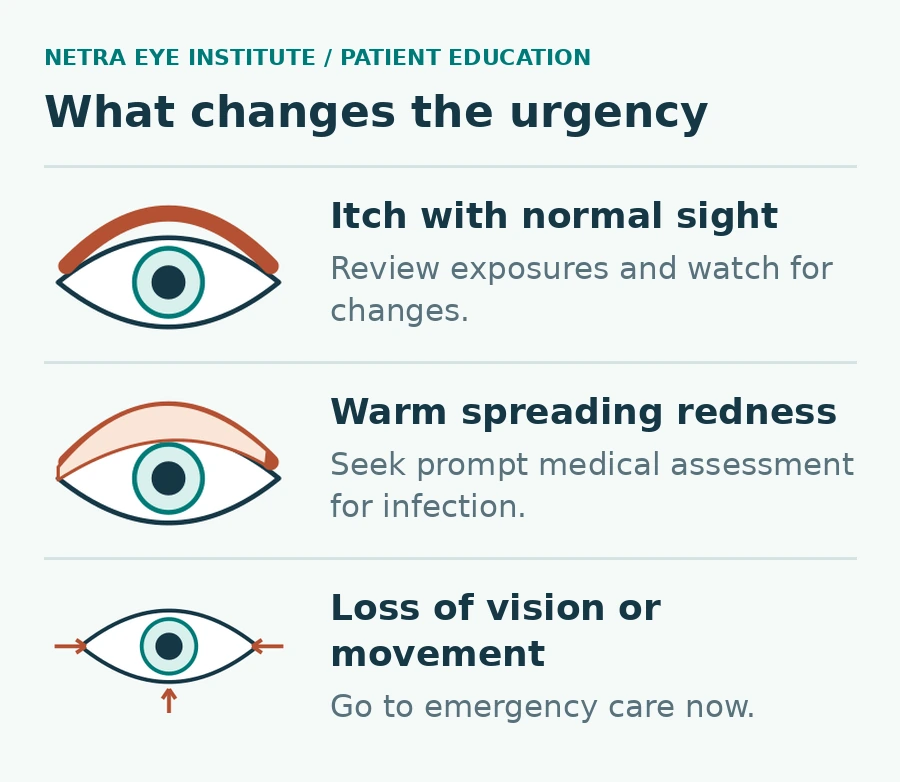
Think of three levels of urgency. Itching with normal sight usually means a surface reaction. Warm, spreading redness needs a same-day visit. Loss of vision or eye movement means emergency care now [1,2,5].
The fastest way to heal a swollen eyelid is to treat its cause. For allergic puffiness, remove the trigger, use a clean cool compress, and consider an antihistamine [7]. For a stye or chalazion, use warm compresses several times a day and do not squeeze [9]. An infection needs a doctor and often antibiotics [5].
For mild, itchy or slightly tender swelling with normal vision:
Keep using prescribed eye drops, such as glaucoma drops, unless the prescriber says to stop. See a doctor if an eyelid bump does not improve within a week or two [9].
An infected eyelid is usually red, warm, tender and swollen. With normal vision and eye movement, it is most likely preseptal (periorbital) cellulitis, an infection in front of the eye socket [5,11]. If moving the eye hurts, vision changes, or the eye bulges, it may be orbital cellulitis, an emergency [2].
| Feature | Preseptal (periorbital) cellulitis | Orbital cellulitis |
|---|---|---|
| Vision and eye movement | Normal [1] | Vision may drop. Movement painful or limited, sometimes double vision [1,2] |
| Bulging eye | No [1] | Often [1] |
| Fever | Sometimes [1] | Common, often 102°F (38.8°C) or higher [2] |
| Usual start | A scratch, bite, or nearby infection such as sinusitis [5] | Often a sinus infection, sometimes a tooth infection [1,2] |
| Treatment | Antibiotics by mouth, shot or IV [5] | Hospital IV antibiotics, sometimes surgery [2] |
| How fast to act | Same-day doctor visit | Emergency room now |
Preseptal cellulitis is more common in children younger than 5 [5,11]. With the right antibiotics, most cases clear within 5 to 7 days [11]. Doctors may treat it at home with antibiotic pills if they can fully examine the eye and follow-up is assured [4]. Call right away if swelling spreads or moving the eye starts to hurt [5].
Orbital cellulitis can worsen quickly and can cause vision loss [2]. Doctors usually order a CT or MRI scan [1,2]. Do not wait for a fever if moving the eye hurts. Do not pry a child's swollen lids open to test vision.
Allergic eyelid swelling is usually itchy and mild. It becomes an emergency when it comes with swelling of the lips, tongue or throat, hives, wheezing, trouble breathing, or feeling faint [3,12]. These can be signs of anaphylaxis, a severe whole-body reaction. Use epinephrine if you have it and call 911 [3].
A very hoarse or whispered voice is a warning sign of throat swelling [3]. Do not wait to see if an allergy pill works, and give nothing by mouth to someone struggling to breathe [3]. Symptoms can return hours later, so stay under medical care after treatment [13].
Angioedema is swelling of deeper skin layers. It can affect the lids, lips and throat, and it is dangerous in the throat [12,14]. Painless, pale swelling suggests angioedema [1]. It can occur without hives [14]. Some medicines, including ACE inhibitor blood pressure pills and NSAID pain relievers, can cause it [14].
After an injury, get emergency care for vision changes, double vision, trouble moving the eye, or a possible cut to the eye [4]. After surgery, call your surgical team first. A painful, blistering rash may be shingles and needs a same-day visit [4].
Do not press on the eye. In children, a trapdoor fracture of the eye socket can trap eye tissue, sharply limit eye movement, and trigger a reflex that slows the heart. It is usually repaired within 24 hours [15]. Tell the team about any head injury, fainting, or blood thinner use.
Some bruising and swelling are expected. Call your surgical team right away for new pain, reduced vision, a tense or bulging eye, or swelling that worsens after improving. Use only the aftercare products they recommend.
Shingles near the eye causes painful blisters on the forehead and upper lid, on one side [1,4]. Blisters on the nose raise the chance that the eye itself is involved [4]. Antiviral medicine should start promptly [4]. Do not put steroid cream near the eye unless a doctor advises it.
Yes. Eyelid skin is the thinnest skin on the body, so allergens pass through it easily, and hands carry products to the lids [8]. An allergic skin reaction usually peaks 1 to 2 days after contact, which can hide the trigger [8].
A Mayo Clinic study patch-tested 215 people with eyelid dermatitis [8]. The top allergen groups were metals (such as nickel in eyeglass frames), shellac in skin products, and preservatives. Next came topical antibiotics, fragrances, acrylates in artificial nails, and surfactants in tear-free shampoos [8]. One preservative, benzalkonium chloride, is found in some prescription and over-the-counter eye drops [8].
List every product that touches your face, hands and hair, and change one thing at a time. If reactions keep returning, a dermatologist or allergist can do patch testing [8]. Do not stop prescribed eye drops on your own. Ask whether a preservative-free version is possible [8].
The doctor will ask when the swelling started, whether it itches or hurts, and about allergies, products, injuries and recent illness [1]. They will check vision in each eye, eye movements, and the lids and eye surface [1]. Most causes are diagnosed this way. A CT or MRI scan is used when a deeper infection is suspected [1].
Bring your glasses and a list of medicines, eye drops and skin products. For a suspected body-wide cause, blood and thyroid tests may be ordered [1].
No. Netra Restoration Therapy (NRT) is not a treatment for a swollen eyelid. It has not been tested in controlled trials for eyelid swelling, styes, eyelid infections or allergic reactions. A swollen eyelid needs a diagnosis and standard medical care first, and complementary care should never delay it.
Netra describes Netra Restoration Therapy as adjunctive care based on principles from Traditional Chinese Medicine and Ayurveda. It is meant to be used alongside, not instead of, care from an eye doctor, and Netra states that it is not a cure [16].
If you receive NRT for another eye condition, tell your eye doctor and the Netra team about new eyelid swelling. Pause treatment around the eyes until your eye doctor says it is safe. Do not put herbal balms, oils or unprescribed drops on a swollen lid.
Some people with a diagnosed, long-term lid condition, such as ocular rosacea, ask about complementary care for comfort. That should only be added to their eye doctor's plan. Netra's page on NRT effectiveness explains why results are judged condition by condition and are not guaranteed [17].
Use a clean, cool compress for itchy, allergic puffiness and a warm compress for a stye or chalazion. Never put ice directly on the eyelid. A lid that is red, hot and getting worse needs a doctor, not just home care.
Eye allergies often make the eyelids puffiest in the morning. If morning puffiness keeps happening, affects both eyes along with swollen feet or ankles, or comes with other symptoms, see your doctor. They can check for kidney, heart, liver or thyroid problems.
Yes. An allergic or skin reaction can affect one eyelid or both, often depending on where the trigger touched. One-sided swelling that is painful, warm or spreading is more likely an infection and needs a doctor.
Swelling from an allergy, a skin reaction or a blocked gland is not an infection, so it cannot spread to others. If an infection may be the cause, wash your hands often and do not share towels or eye makeup. See a doctor if the eye is red with discharge.
Yes. Infection can spread from the sinuses, or less often from a tooth, into the tissues around the eye. This is a common way orbital cellulitis starts, especially in children. Eyelid swelling with fever during or after a sinus infection needs urgent care.
A child with a red, warm, swollen eyelid should see a doctor the same day. This kind of eyelid infection is most common in children under 5. Go to the emergency room if the child has a fever and seems ill, cannot open the eye, or has pain moving the eye. Do not pry the eyelids open to check vision.
Go to the ER for vision changes, pain moving the eye, a bulging eye, a red swollen lid with fever, or a serious eye injury. Call 911 for swelling of the lips, tongue or throat, or trouble breathing. Urgent care or your own doctor can usually see a mild, itchy eyelid when vision is normal.
Sources checked October 31, 2026.
This article provides general education and does not replace an individual eye examination, diagnosis or treatment plan. If a swollen eyelid comes with vision changes, pain when moving the eye, a bulging eye, fever, or any trouble breathing or swallowing, call 911 or go to the nearest emergency room now.