Search conditions, treatments, research reviews and articles. Press Enter to see all results, Esc to close.
Search conditions, treatments, research reviews and articles. Press Enter to see all results, Esc to close.

Blog
October 31, 2026
Double vision (diplopia) means seeing two images of one object. Doubling that stops when you cover either eye means the eyes are out of line, and new cases need medical care right away. Doubling that stays in one eye usually comes from that eye, such as dry eye, astigmatism or a cataract [1,3].
This article is general education and does not replace an eye exam. Double vision with a droopy eyelid, a sudden severe headache, weakness, numbness or trouble speaking is an emergency. Call 911. Don't drive while you are seeing double.
Key takeaways
In this article
Call 911 or go to the emergency department now if double vision comes with any of these:
Get medical care right away, often in an emergency department, even if the double vision has already stopped, if:
If the doubling is only in one eye, came on slowly and you have no other symptoms, see an eye doctor within a few days [3]. If a stroke is possible, note the time the symptoms first appeared [8]. Have someone else drive you. Netra's guide to urgent vision changes covers other eye emergencies.
Double vision, or diplopia, is seeing two images of a single object at the same time. The second image may sit beside, above or at an angle to the first, or look like a faint shadow. It happens when one eye's image is distorted or when the two eyes stop pointing at the same target [1,4].
To see one image, each eye has to form a clear picture, and both eyes have to aim at the same spot. The brain then merges the two views. Double vision means one of those steps has failed.
People describe it in different ways. When the eyes are out of line side to side, the two images sit side by side. When they are out of line up and down, one image sits above the other [5]. A faint ghost or echo next to letters or lights is more typical of an optical problem in one eye. Images can also look tilted.
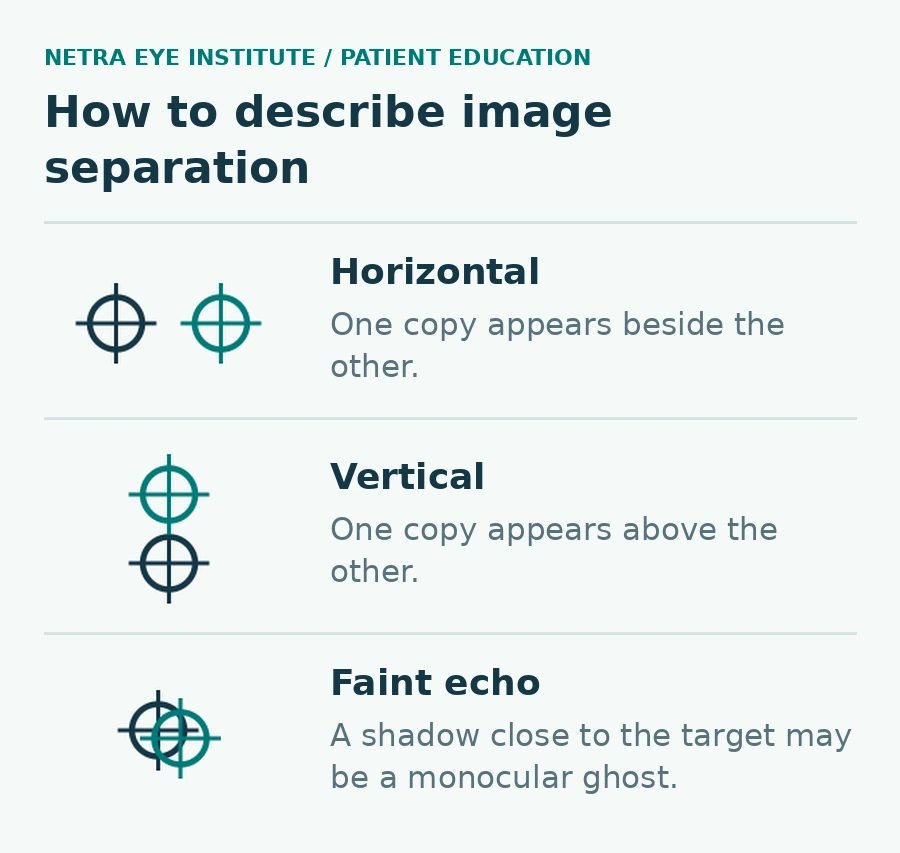
Double vision is not the same as blur. Blur means details look fuzzy. Double vision means you see a second copy, even if it is faint. Some people have both.
Cover one eye, then the other. If the doubling disappears when either eye is covered, you have binocular double vision, which means the eyes are out of line. If it stays when one eye is open on its own, you have monocular double vision, which comes from that eye. This is the most useful first clue [1,3].
Skip this check and call 911 if you have any emergency warning signs. In the example below, the target is double with both eyes open but single with either eye alone. That pattern is binocular double vision.
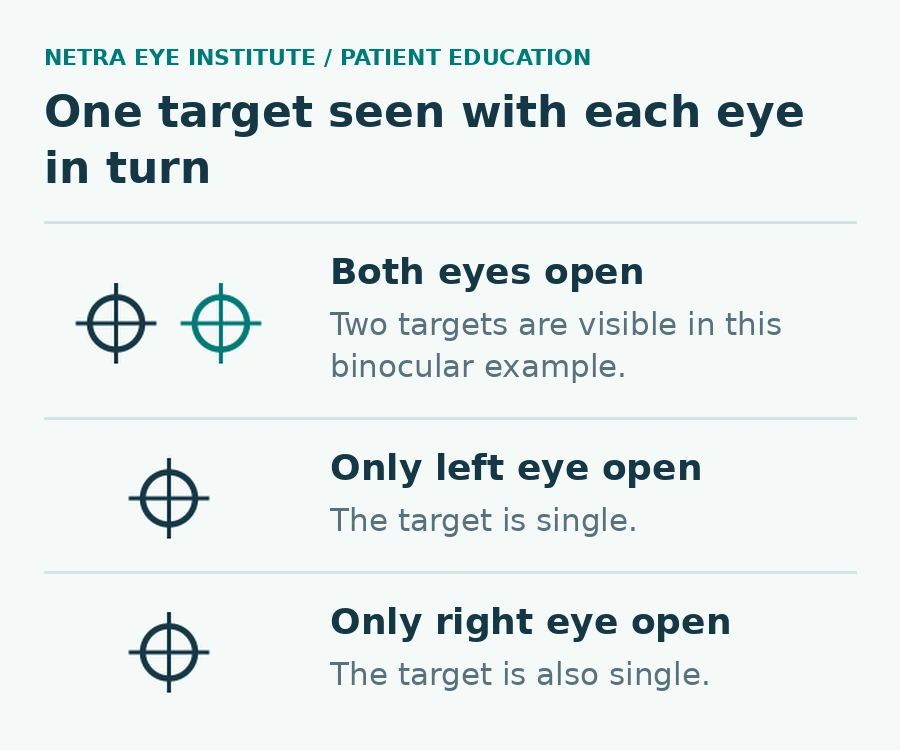
Covering one eye can bring relief in both kinds, so relief alone tells you little. The key is what each eye sees on its own. You can have both kinds at once, so tell your doctor everything you notice.
| Feature | Double vision in one eye (monocular) | Double vision with both eyes (binocular) |
|---|---|---|
| Cover test | Stays when the affected eye is open alone | Goes away when either eye is covered |
| What is wrong | Light is distorted inside one eye | The two eyes are out of line |
| Common causes | Dry eye, uncorrected astigmatism, keratoconus, cataract, some retina problems | Cranial nerve palsy, myasthenia gravis, thyroid eye disease, eye socket injury, stroke |
| How often | Less common | More common |
| How soon to get care | Within a few days if there are no other symptoms | Right away, often in an emergency department; call 911 if there are warning signs |
Double vision in one eye usually comes from something that distorts light inside that eye. Common causes are dry eye, the need for glasses (especially uncorrected astigmatism), cornea shape problems such as keratoconus, and cataract. Less often, a problem in the macula, the center of the retina, causes it [1,3,5].
In the office, looking through a pinhole often clears doubling that has an optical cause [5]. Because the problem sits in the eye, an eye exam is the right first step.
Binocular double vision happens when the eyes don't point at the same target. The most common causes are a weak eye-movement nerve (cranial nerve palsy), myasthenia gravis, and eye socket problems such as thyroid eye disease. Injury, stroke, multiple sclerosis and an old childhood eye turn that breaks down are other causes [3,4,5].
Three cranial nerves move each eye: the third, fourth and sixth. A sixth nerve palsy weakens the eye's ability to turn outward. The images sit side by side and get worse looking toward the weak side [4]. A fourth nerve palsy causes images stacked one above the other, worse looking down, and people often tilt their head to help [4]. A third nerve palsy can cause a droopy lid, an eye that turns out and down, and sometimes a large pupil [4].
One type is a microvascular cranial nerve palsy, caused by poor blood flow to the nerve. It is linked to diabetes, high blood pressure and high cholesterol. Most people recover fully, usually over 6 to 12 weeks [2]. Doctors may still order scans and blood tests to rule out inflammation or pressure on the nerve [2].
A third nerve palsy that affects the pupil can mean an aneurysm, a bulge in a brain artery, is pressing on the nerve. Any new third nerve palsy needs emergency imaging [5,6]. A droopy eyelid (ptosis) that appears suddenly with double vision is a warning sign.
Myasthenia gravis is an immune disease that makes muscles weaken with use. Double vision and drooping eyelids are the most common first symptoms. Weakness gets worse with activity and improves with rest, so symptoms can build as the day goes on [9]. Trouble breathing or swallowing is an emergency [9].
Thyroid eye disease is an autoimmune condition that most often affects people with Graves disease. It can cause double vision, bulging eyes, eyelids that pull back, and dry, gritty eyes [10]. Prism glasses or eye muscle surgery can help the double vision [10]. Eye drops can ease the dryness, but they do not realign the eyes.
A blow to the eye area can break the thin bones of the eye socket. Double vision can come from swelling or from an eye muscle or tissue trapped in the break. Trapped tissue happens most often in children, teens and young adults, and it needs urgent repair [11]. Get seen urgently after any eye injury that causes double vision.
Brain and nerve conditions that can cause double vision include:
Some adults had a childhood eye turn (strabismus) that the brain learned to manage. Years later, that control can break down and cause double vision [5]. An old eye turn does not rule out a new problem, so new symptoms still need a full exam.
Convergence insufficiency means the eyes struggle to turn inward together for close work. It can cause double vision when reading or using a phone. Treatment often includes vision therapy with a specialist, home exercises or prism glasses [12].
Sudden double vision can come from a stroke, an aneurysm, a cranial nerve palsy, an eye socket injury or a myasthenia gravis flare. Double vision that comes and goes can point to myasthenia gravis, multiple sclerosis or an old eye turn breaking down. Even if it goes away, get it checked [3,4,5].
Brief double vision can still signal a serious problem. MedlinePlus advises emergency care for double vision even when it is temporary [7]. The MSD Manual says double vision should always be checked by a doctor, even if it has stopped [3].
If your double vision comes and goes, keep short notes. Write down the time, what you were doing, whether the images were side by side or stacked, and whether covering either eye made them single. A photo of a droopy eyelid when it happens can help. Don't repeat tiring tasks just to bring it on.
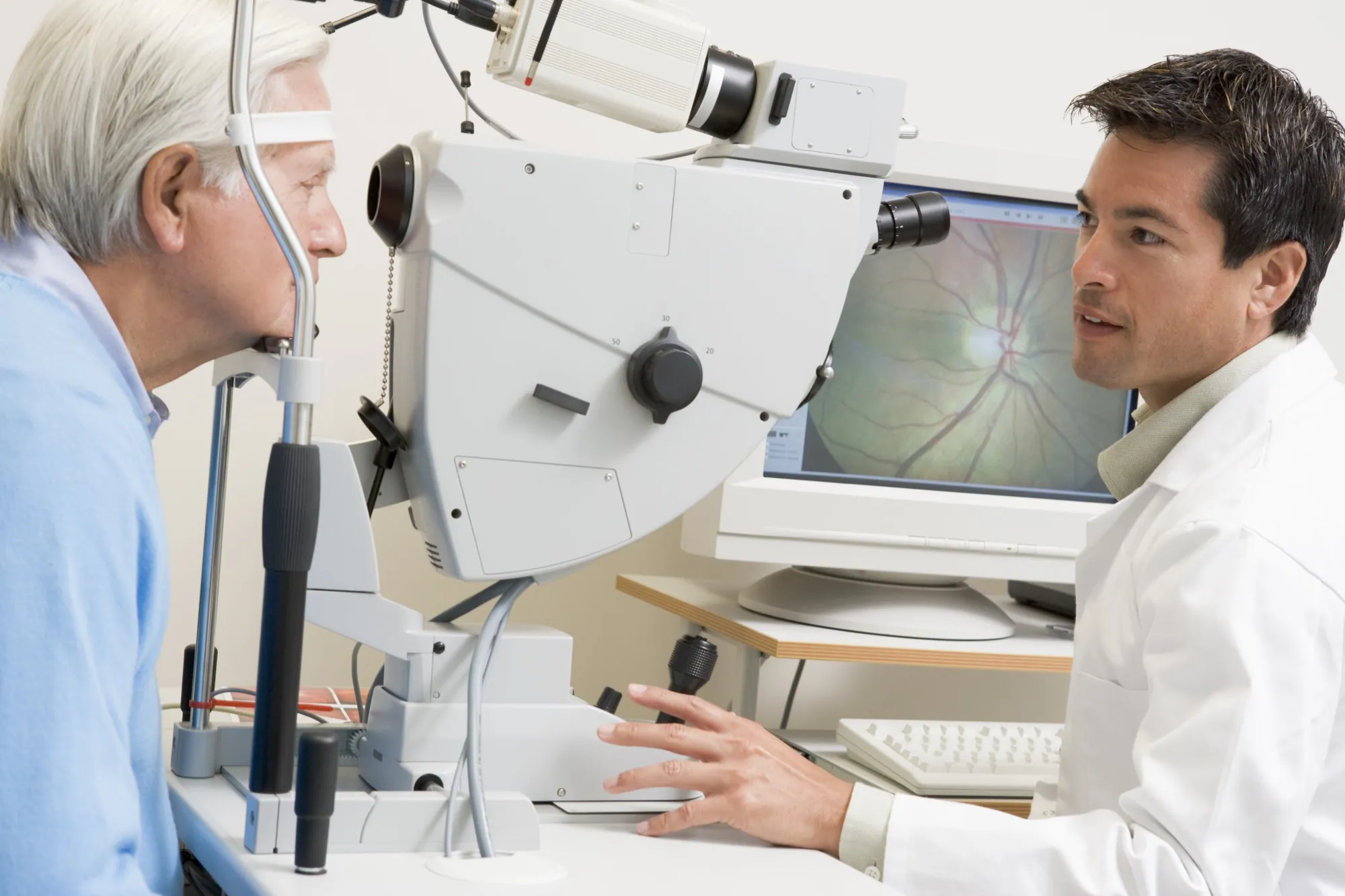
The eye exam matters most. The doctor checks vision in each eye, the eyelids, the pupils and how the eyes move in every direction. A cover test with prisms measures how far out of line the eyes are. Brain imaging and blood tests are added when warning signs or the pattern call for them [3,4,5].
Expect questions about when it started, whether the images are side by side or stacked, and whether they change up close or far away. Your doctor will also ask about pain, droopy lids, numbness, weakness and balance [1].
Imaging with MRI or CT is needed for anyone with red flags. These include more than one nerve involved, any pupil change, other nerve symptoms, pain or a bulging eye [4]. People over 50 are asked about symptoms of giant cell arteritis [5]. Blood tests may check for myasthenia gravis antibodies or thyroid problems [4,5].
Treatment starts with the cause. That might mean glasses or dry eye care for one-eye doubling, or medical care for a nerve, muscle or thyroid problem. While that works, a patch, tape on one glasses lens or a prism can stop the second image. Eye muscle surgery may help a misalignment that has stopped changing [1,2,4,5].
Patching either eye, or putting tape on one glasses lens, removes the second image [1,2]. It does not fix the cause. It also takes away depth perception, so take care on stairs and around hot pans. Do not patch a child's eye unless an eye doctor tells you to, because patching affects how a child's vision develops [13].
A prism bends light and shifts the image so the views from the two eyes line up [1]. Temporary stick-on prisms can be changed while the alignment is still changing [2]. Prisms work best for small misalignments [5]. A prism that helps when you look straight ahead may help less when you look to the side.
When the misalignment is stable, eye muscle surgery can realign the eyes [1,5,10]. Botulinum toxin injections into an eye muscle are sometimes used, but the effect is hard to predict and wears off [5]. For a microvascular palsy, no treatment speeds recovery, so patching or prisms are used while the nerve heals [2].
In daily life, don't drive while you see double. Light your stairs well and ask for help on unfamiliar routes. Tell people at work which tasks are hard, such as reading columns of numbers.
Children may never notice or mention double vision. A child's brain may learn to ignore the image from a misaligned eye, which can lead to lazy eye (amblyopia). Watch for an eye that turns in, out, up or down, or eyes that don't move together. A new eye turn should be checked promptly [13].
Get care the same day if a new eye turn comes with headache, vomiting, weakness, an injury or a change in behavior. Treatment depends on the cause and may include glasses, patching the stronger eye, or eye muscle surgery [13]. Follow the patching plan exactly as prescribed. See Netra's guide to children's vision warning signs.
Netra Restoration Therapy (NRT) is not a treatment for double vision. It has not been tested in controlled trials for diplopia. It cannot fix a nerve palsy, an aneurysm, a misaligned eye or a stroke. Sudden double vision needs urgent medical care first, and NRT should never delay it [15,16].
Netra Restoration Therapy is an integrative program based on traditional Chinese medicine and Ayurvedic principles, including acupuncture. Netra uses it alongside the diagnosis, monitoring and treatment from your eye doctors, never instead of them [15].
A person with a separate, diagnosed and stable eye condition might ask about NRT as complementary support. One example is chronic dry eye that has already been assessed and treated. Agree on a measurable daily goal in advance. Netra explains how it reviews outcomes on its NRT effectiveness page [16].
Keep alignment measurements and prism changes with your eye doctor or orthoptist. If double vision gets worse, a lid starts to droop or vision changes suddenly, stop elective care and get medical help.
Binocular double vision, the kind that goes away when either eye is covered, is more common than double vision in one eye [3]. Its most common causes are cranial nerve palsies, myasthenia gravis and eye socket problems such as thyroid eye disease [3,4]. In one eye, the most common causes are cataract, cornea shape problems and uncorrected astigmatism [3].
Yes. Dry eye is one of the common causes of double vision in one eye [1]. This kind of doubling stays when only the affected eye is open. If the doubling goes away when you cover either eye, dry eye is not the main cause, and you need a medical check right away [1,3].
It can be. A stroke in the brainstem can cause double vision, usually along with dizziness, trouble speaking, weakness or numbness [4,5,8]. If double vision comes with any of these, call 911 right away. Double vision alone has many causes, but new double vision still needs prompt care [3].
It depends on the cause. Double vision from a microvascular nerve palsy usually clears over 6 to 12 weeks, and most people recover fully [2]. Other causes need treatment. Don't wait to see if it clears; get checked first [3].
Double vision only up close is often caused by convergence insufficiency, where the eyes struggle to turn inward together for near work [12]. A fourth nerve palsy can also cause stacked images that are worse when looking down, as you do when reading [4]. An eye exam can tell these apart.
Yes. Diabetes raises the risk of a microvascular cranial nerve palsy, where poor blood flow stops an eye-movement nerve from working for a time [2]. Most people recover within 6 to 12 weeks [2]. Diabetes can also affect other parts of the eye, so new double vision still needs a full exam.
No. Don't drive while you see double, and don't drive with one eye covered until a doctor says it is safe. Covering an eye removes depth perception. Have someone else take you to get checked.
Covering one eye stops binocular double vision because it removes the second image [1]. It does not treat the cause. Relief from covering an eye does not mean the cause is harmless, so new double vision still needs a medical check [3].
Sources checked October 31, 2026.
This article provides general education and does not replace an individual eye examination, diagnosis or treatment plan. If double vision starts suddenly or comes with a droopy eyelid, a severe headache, weakness, numbness or trouble speaking, call 911.