Search conditions, treatments, research reviews and articles. Press Enter to see all results, Esc to close.
Search conditions, treatments, research reviews and articles. Press Enter to see all results, Esc to close.
Blog
October 31, 2026
A stye (hordeolum) is a red, painful bump at the edge of the eyelid. It is usually a bacterial infection of an eyelash follicle or oil gland [1,2]. A chalazion is a firm, usually painless lump deeper in the lid, caused by a blocked oil gland rather than an infection [1,3].
Both usually get better with warm compresses. Most styes drain within 2 to 4 days, while a chalazion can take 2 to 8 weeks to go away [2].
Key takeaways
In this article
This article is general education, not a diagnosis. If you are unsure what an eyelid bump is, or it is getting worse, have it checked by an eye doctor.
A stye is an acute infection, usually with staph bacteria, of an eyelash follicle or a small oil gland in the eyelid. It is painful and usually sits at the lid edge. A chalazion forms when an oil gland, called a meibomian gland, gets blocked. It is not an infection, is usually painless, and sits farther back in the lid [1,2].
| Feature | Stye (hordeolum) | Chalazion |
|---|---|---|
| What it is | An infected eyelash follicle or oil gland [1] | A blocked oil gland with inflammation around it, not an infection [1] |
| Cause | Bacteria, usually staph [2,4] | Thick or trapped oil in a meibomian gland [1] |
| Pain | Painful and tender [2] | Usually painless after the first few days [2] |
| Where | At the lash line, or on the inner side of the lid (internal stye) [1] | In the body of the lid, set back from the lashes [1] |
| Look | Red, pimple-like bump, often with a small yellow spot [2,5] | Round, firm lump under the skin [2,3] |
| Usual course | Comes to a head and drains in 2 to 4 days [2] | Often goes away in 2 to 8 weeks [2] |
| First treatment | Warm compresses. Do not squeeze [2,5] | Warm compresses. Do not squeeze [2,3] |
| If it lasts | A doctor may open and drain it [1,5] | Steroid injection or drainage [1,3] |
Early on, a chalazion can look exactly like a stye [1]. A chalazion often follows an internal stye. The redness and pain fade, but the blocked gland does not drain and leaves a firm, non-tender lump [3].

Most styes and chalazia heal with home care. But infection can spread into the eyelid, and a few lumps are not what they seem [1,5].
Get emergency care now if:
See a doctor soon if:
See Netra's guide to urgent vision changes for other warning signs.
A stye is a red, swollen bump on the edge of the eyelid. It looks like a pimple and is tender to touch [5]. It usually grows over a few days and may form a small yellow spot at the base of a lash. The eye may water, feel gritty, or be sensitive to light [2,5].
There are two types. An external stye forms at the base of an eyelash and is the most common [1]. An internal stye forms in a meibomian gland on the inner side of the lid. It can be more painful and swollen, rarely bursts on its own, and tends to come back [1,2].
If redness spreads across the whole eyelid, the infection may have moved into the lid tissue (eyelid cellulitis). This can need antibiotic pills and should be seen by a doctor [1,5].
A stye starts when an oil gland or eyelash follicle at the lid edge gets blocked and bacteria grow inside it [5]. The usual germ is Staphylococcus aureus (staph) [2,4]. Repeated styes are linked to blepharitis, rosacea and diabetes, and Demodex eyelash mites can make styes worse [4,5].
If you get styes often, ask your eye doctor to check for an ongoing lid condition. Netra's guides to Demodex blepharitis and ocular rosacea explain two common ones.
A chalazion is a small, firm lump caused by a blocked meibomian gland. These oil glands sit in the lid just behind the lashes [3]. It grows slowly and is usually painless [2,8]. Other painless eyelid bumps include yellow patches called xanthelasma, small skin-colored growths (papillomas), and cysts [5].
Meibomian glands make an oily fluid that helps keep the eye's surface moist [3]. Netra's article on tear film layers explains how this oil works. When these glands make thick oil, as in meibomian gland dysfunction or rosacea, chalazia are more likely [1].
A large chalazion can press on the front of the eye and change its shape. That can cause blurry vision from astigmatism [1]. Rarely, an eyelid skin cancer can look like a chalazion [3].
Most styes go away on their own. To help one drain, hold a clean, warm, wet cloth on the closed eyelid for about 10 minutes, several times a day [2,5]. Do not squeeze or pop it. Skip eye makeup and contact lenses until it heals, and see a doctor if it is not better in a week or two [5].
The same routine is the first treatment for a chalazion. Warmth may soften the hardened oil blocking the gland so it can drain [3]. If your doctor suggests gentle lid massage, ask them to show you how, and never press on the eyeball.
If a stye drains by itself, gently clean the outside of the lid and wash your hands.
No home remedy is proven to clear a stye overnight. Warm compresses help it come to a head and drain, which usually happens within 2 to 4 days [2]. Squeezing it to speed things up is not safe [5]. If a stye is very painful or not improving, an eye doctor can open and drain it [1,5].
Most styes come to a head and drain within 2 to 4 days, and the pain eases once they drain [2]. A chalazion takes longer. Most go away without treatment within 2 to 8 weeks [2]. See a doctor if a stye is not improving after a week or two, or if a chalazion keeps growing [3,5].
Older chalazia are harder to clear with home care. In a trial of 149 people, only about 1 in 5 chalazia fully cleared after 4 to 6 weeks of warm compresses [9]. On average, lumps shrank by about 1 to 2 mm [9]. Lumps that cleared had been present for a shorter time, about 1.5 months versus 2.2 months [9]. The authors suggested considering a procedure for chalazia present more than 2 months [9].
Usually not. A chalazion is not an infection, so antibiotics rarely help. Antibiotic drops or ointment usually do not help much for a simple stye either [2]. Antibiotic pills are used when infection spreads into the eyelid (cellulitis) and for some internal styes [1].
Studies agree. In the trial above, adding tobramycin drops, or tobramycin with a steroid, did not help chalazia clear [9]. A review of 2,712 patient records found antibiotics were used in about 1 in 3 cases. They did not improve healing of styes or chalazia [10]. If you are prescribed an antibiotic, ask what it is meant to treat.
If a chalazion lasts more than several weeks despite warm compresses, is large, or blurs vision, an eye doctor can treat it. Options are a small steroid injection into the lump, or opening and draining it, usually from inside the lid (incision and curettage) [1,3]. A lump that keeps returning may need a biopsy [1].
| Feature | Steroid injection | Incision and curettage (drainage) |
|---|---|---|
| What happens | A small dose of steroid (triamcinolone) is injected to calm the inflammation [1,11] | The lump is opened, usually from inside the lid, and its contents removed [3] |
| Results in trials | About 81% to 84% cleared [11,12] | About 79% to 87% cleared [11,12] |
| Comfort | Less pain and inconvenience in one trial [12] | More pain than injection in one trial [12] |
| Possible side effects | Lighter skin at the injection site, more common in darker skin [13]. Case reports describe thinning of the fat under the skin [14] | Eyelash loss, a small notch in the lid edge or, rarely, a skin scar [3] |
In one trial, based on patient reports by phone at 3 weeks, 46% of chalazia cleared with warm compresses alone. That compared with 84% after injection and 87% after drainage [12]. In another trial, lumps cleared about 5 days after an injection on average [11]. Those authors suggested injection when the diagnosis is clear and no biopsy is needed [11]. Both were small, single-hospital studies.
Before a procedure, tell the doctor about blood thinners, but do not stop them on your own. Ask whether you can drive home if the eye will be covered. Chalazia can come back after they heal [3].
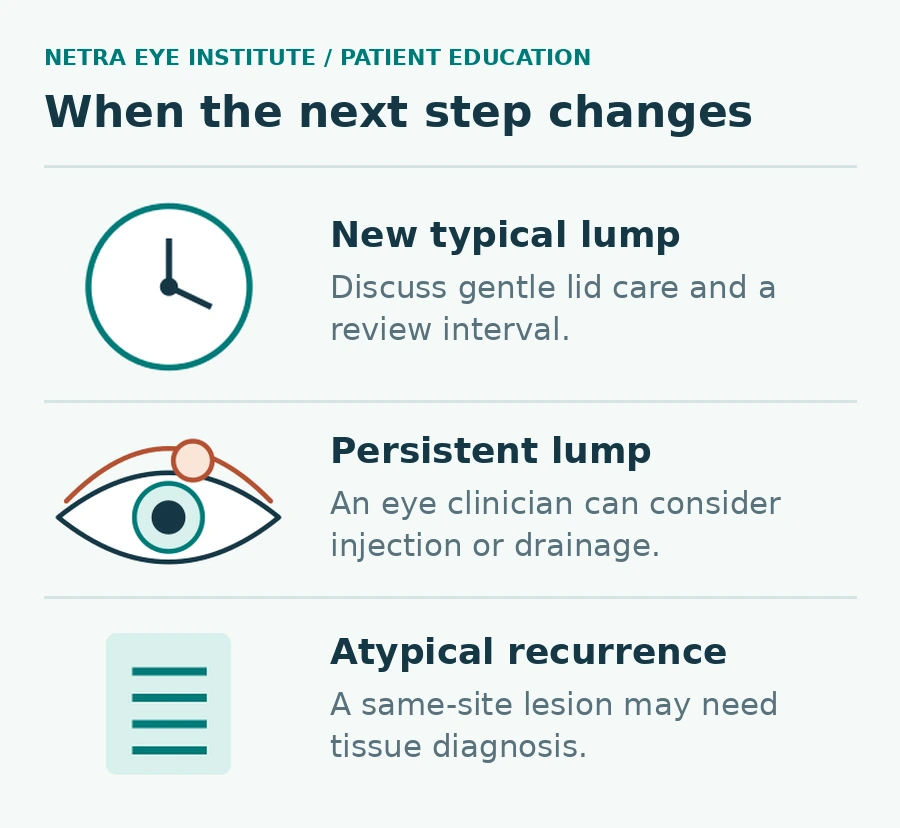
Repeated styes or chalazia usually point to an ongoing eyelid problem, such as blepharitis, meibomian gland dysfunction, Demodex mites or rosacea [1,4,5]. Treating that condition may help prevent new lumps [5]. A lump that returns in exactly the same spot is different. It needs an exam and possibly a biopsy [1,8].
For prevention, MedlinePlus suggests a daily warm compress followed by gentle cleaning along the lash line with eye cleansing pads or diluted baby shampoo [3]. Tear-free shampoos contain surfactants, which were a common cause of allergic eyelid dermatitis in one patch-test study [15]. If a cleanser makes your lids red or itchy, stop it and ask your doctor about other options.
Ask for a closer look if a lump returns in the same place, keeps growing, bleeds, or causes eyelash loss [3,5]. Recurrent chalazia should be checked for cancer, which is rare [3,8]. A biopsy request does not mean cancer has been found; it is how doctors rule it out [1]. Netra's guide to dry eye and meibomian gland testing explains how doctors check the oil glands.
The same home care usually works, but children need closer watching. In young children, chalazia are linked with astigmatism [7]. The risk is higher when the lump is on the upper lid, is 3 mm or larger, or there is more than one [7]. Untreated focusing problems can lead to a lazy eye (amblyopia) [16].
In a study of 381 children with chalazia, those aged 4 to 8 more often had focusing problems linked to amblyopia [16]. Orbital cellulitis, a deep infection around the eye, can get worse very quickly in children and threaten vision [6].
Have a child's eyes checked if a lump is large, presses on the eye, or keeps coming back. Also get a check if the child squints, rubs or closes one eye. Test the compress on your own wrist first. Netra's guide to children's vision warning signs lists other reasons for an exam.
No. Netra Restoration Therapy (NRT) is not a treatment for styes or chalazia, and it has not been tested in controlled trials for either one. It cannot drain a stye, remove a chalazion, or show whether a lump is harmless. Use the standard care above, and never delay seeing an eye doctor to try complementary care.
Netra describes Netra Restoration Therapy as adjunctive care based on principles from Traditional Chinese Medicine and Ayurveda. It is used alongside, not instead of, care from an eye doctor, and Netra states that it is not a cure [17].
Some people with repeated lumps also have ongoing burning or gritty eyes from meibomian gland dysfunction, rosacea or evaporative dry eye. If they ask about complementary care for that discomfort, it should only be added to their eye doctor's plan. The lumps still follow standard care.
Evidence here is limited. In one small sham-controlled dry-eye trial of 49 people, acupuncture improved some symptom scores but not tear or eye-surface tests [18]. That trial did not test NRT and did not include styes or chalazia. Netra's NRT effectiveness page explains why it judges results condition by condition and does not guarantee outcomes [19].
Do not put herbal oils, balms or unprescribed drops on an inflamed eyelid. Tell your eye doctor about any complementary care, especially before a procedure.
A chalazion is not contagious because it is not an infection. A stye is caused by bacteria, usually staph, so it makes sense to keep those germs to yourself. Wash your hands before and after touching your eye, do not share towels, and skip eye makeup and contact lenses until it heals.
Yes. If a stye's blocked gland does not drain, the redness and pain can fade while a firm, painless lump stays behind. That lump is a chalazion, and it can take several weeks to go away.
No. Squeezing, popping or pricking an eyelid bump is not safe. Let it drain on its own with warm compresses. If it needs draining, an eye doctor can open it safely in the office.
It is best to skip eye makeup and contact lenses until a stye has fully healed. Wear glasses instead, and wash your hands before touching your eyes. Do not share eye makeup with anyone.
A chalazion is almost always harmless and often goes away on its own. Rarely, an eyelid cancer can look like a chalazion. See an eye doctor if a lump keeps growing, comes back in the same spot, bleeds, or causes eyelash loss.
Yes, most chalazia go away without treatment within 2 to 8 weeks. Warm compresses several times a day may help. If a chalazion lasts longer, is large, or blurs your vision, an eye doctor can inject or drain it.
Usually yes, if you feel well and can see clearly. Wash your hands often and do not share towels. See a doctor instead if you have a fever, redness spreading across the lid, or trouble seeing.
Wash your hands before touching your eyes, and keep your eyelids clean. If you get them often, a daily warm compress followed by gentle cleaning along the lash line may help. Treating blepharitis or Demodex mites, if you have them, may also help prevent repeat styes.
Sources checked October 31, 2026.
This article provides general education and does not replace an individual eye examination, diagnosis or treatment plan. If an eyelid bump comes with vision changes, pain when moving the eye, a bulging eye, or fever with redness spreading across the lid or face, get emergency care right away.