Search conditions, treatments, research reviews and articles. Press Enter to see all results, Esc to close.
Search conditions, treatments, research reviews and articles. Press Enter to see all results, Esc to close.
Blog
November 6, 2026
Red light therapy reaches one driver of eye disease, mitochondrial energy. See what the trials showed for AMD, myopia, glaucoma and home devices, and how Netra Restoration Therapy addresses the rest.
Key points
Red light therapy for the eyes, known medically as photobiomodulation (PBM), shines low-power red and near-infrared light (about 600 to 900 nanometers) into the eye. The light is absorbed by one enzyme inside the mitochondria, cytochrome c oxidase, which briefly raises the cell's energy output. The evidence is real but narrow. One prescription clinic device is FDA-authorized to improve vision in early-to-intermediate dry macular degeneration, where it added about 2.4 letters over sham treatment. In children with nearsightedness, repeated low-level red light slows eye growth in trials, but retinal injury has been reported. For glaucoma, retinitis pigmentosa and diabetic eye disease, benefit is unproven. Home panels, masks and glasses have not been tested for eye disease and do not control the dose reaching the retina. Red light reaches one driver of eye disease directly. Netra Restoration Therapy (NRT) is designed to address the others.
Key points
See your eye doctor promptly if you have new central blur, distortion, a dark patch or reduced vision, whether or not you are using a light device. Stop using any light device and report the symptom. Flashes, a shower of floaters or a curtain over your vision are emergencies under any therapy.
Photobiomodulation is the use of low-power visible red and near-infrared light to change cell function without heating or damaging tissue. It was first described in the 1960s and has been studied for wound healing, pain and hair growth. Its use in the eye is more recent.
In eye care, the term covers several quite different exposures:
At least five different studied exposures exist. None of them can be reconstructed from “660 nm” on a carton.
Inside every retinal cell, mitochondria turn fuel into energy. Red and near-infrared photons are absorbed by the last enzyme in that chain, cytochrome c oxidase. For a short time the enzyme works harder, a little more ATP is made, and the cell's stress chemistry shifts. Nitric oxide that was holding the enzyme back is released, and a brief pulse of signaling molecules switches on protective genes.
Think of it as sunlight on a solar panel. The panel is the mitochondrion. The right wavelength at the right intensity can top up the battery. The wrong wavelength does nothing, and too much light can damage the panel.
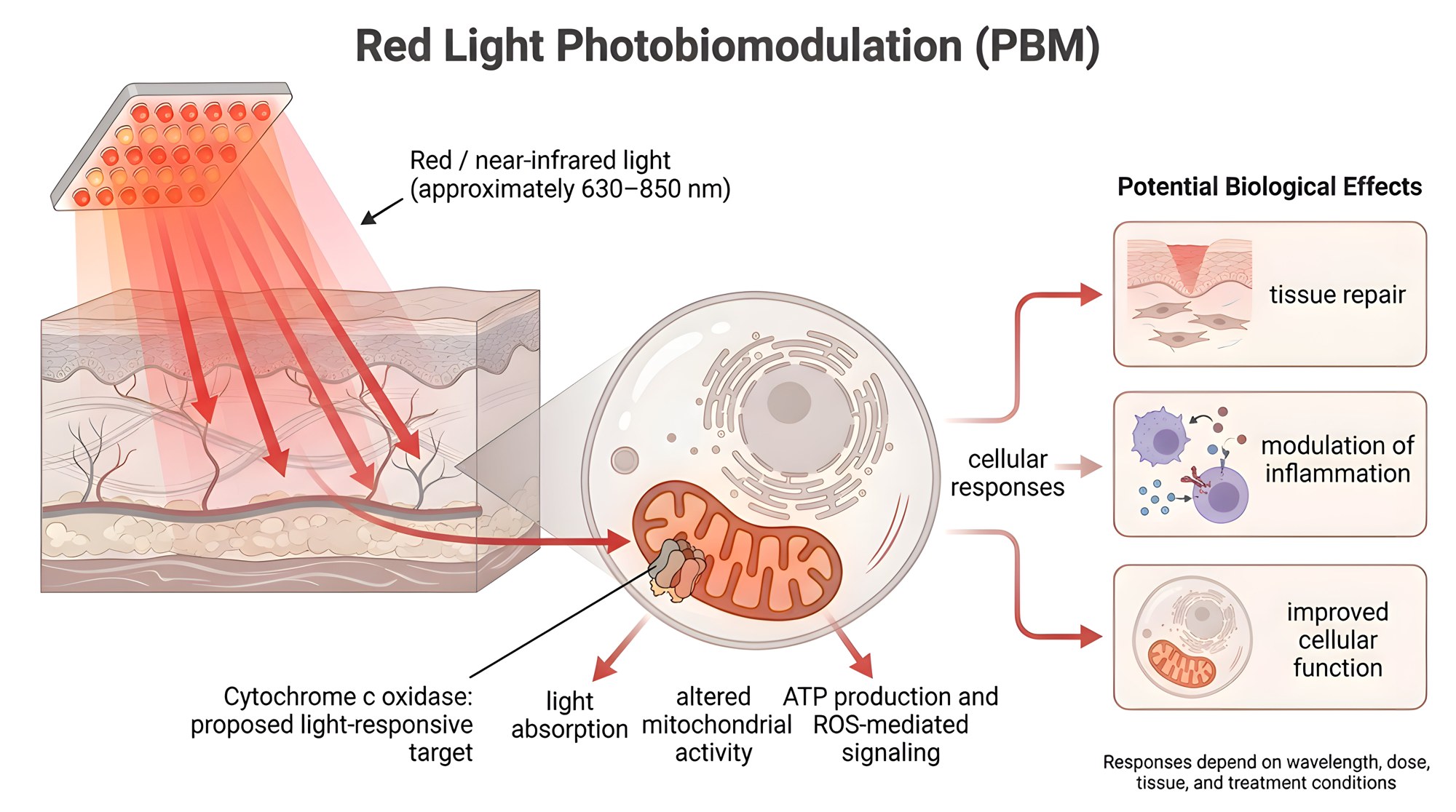
Figure 1: How red light photobiomodulation works. Red and near-infrared light is absorbed by cytochrome c oxidase, the proposed light-responsive target in the mitochondria. The illustration shows the general mechanism in body tissue; in the eye, the light enters through the pupil and reaches the retina. Responses depend on wavelength, dose, tissue and treatment conditions.
For a cell that is tired but alive, that can be meaningful. The retina has the highest energy demand per gram of any tissue in the body, and mitochondrial function declines with age and in disease. A well-known laboratory group reported that a few minutes of 670 nm light in the morning improved color contrast sensitivity in adults over 40 for up to a week; these were small studies, and not all later attempts have reproduced the effect.
The response is biphasic. Low doses stimulate. Higher doses do nothing or inhibit. That is the central practical fact about red light.
The energy that reaches your retina depends on:
A clinic instrument controls all of these. A home panel, mask or wand controls none of them. Two people using the same consumer device at slightly different distances, with different pupil sizes and lens clarity, receive very different retinal doses. A child's clear lens and large pupil transmit far more light than a 70-year-old's.
This is why results from one device cannot be assumed for another, and why “it has the same wavelength as the clinical one” is not a meaningful claim.
Best evidence: LIGHTSITE III: randomized, sham-controlled; 100 people, 148 eyes
What happened: Treated +5.4 letters vs sham +3.0 at 13 months (difference 2.4). New geographic atrophy 5.7% vs 21.6% over two years
Status: FDA-authorized for one prescription device
Best evidence: Several randomized trials, mainly in China
What happened: Slower eye elongation over 6 to 24 months; rebound after stopping in some
Status: Not FDA-authorized; safety concerns; retinal injury case reported
Best evidence: Two studies of 12 people each, no sham group
What happened: About one chart line short-term gain; peripheral vision unchanged; in one study the gain faded by six months
Status: Unproven
Best evidence: DRCR Retina Network Protocol AE: 135 people randomized to 670 nm patch or placebo for four months
What happened: No difference in retinal thickness or vision; not advanced to a larger trial
Status: No benefit shown
Best evidence: Laboratory and animal studies
What happened: Ganglion cells protected in models
Status: No human trial showing optic nerve protection
Best evidence: Small trials of low-level light masks, usually with intense pulsed light
What happened: Improved symptoms and tear stability in some
Status: Limited; treats lids, not retina
Best evidence: Small laboratory studies of 670 nm morning light
What happened: Short-lived improvement in color contrast in some studies; not consistently reproduced
Status: Experimental
This is where red light has its best case.
The trial. LIGHTSITE III randomized 100 people with early-to-intermediate dry AMD to multiwavelength photobiomodulation or sham, given as nine sessions over three to five weeks and repeated every four months for two years.
The result. At 13 months, treated eyes had gained 5.4 letters and sham-treated eyes 3.0, a difference of 2.4 letters, about half a line. Over two years, fewer treated eyes progressed to geographic atrophy (5.7% versus 21.6%). No phototoxicity was seen.
The authorization. In 2024 the FDA authorized that device for one use only: improving vision in early-to-intermediate dry AMD, in eyes with vision of 20/32 to 20/70 and no atrophy at the center.
Reading it fairly. It is a genuine positive trial in a condition that had no treatment at this stage. The average gain is small, the sham group improved too, and the trial was modest in size. It does not show that red light stops AMD.
For the staging of AMD and what else helps, see drusen, dry AMD stages and diet, nutrition and macular degeneration risk.
“Repeated low-level red light” (RLRL) therapy has spread rapidly, particularly in China. Children look into a desktop device emitting about 650 nm light for three minutes, twice a day, five days a week.
Efficacy. Randomized trials report that it slows lengthening of the eye and progression of nearsightedness over one to two years, with an effect size that compares well with other myopia treatments. The choroid thickens, suggesting improved blood flow. When treatment stops, some rebound occurs.
Safety. This is the unresolved issue.
Professional bodies and regulators have urged caution, and these devices are not authorized for myopia by the FDA. Parents considering it should discuss established options first: more outdoor time, low-dose atropine drops, specialized spectacle lenses, and myopia-control contact lenses. See childhood myopia control: evidence and treatments.
Retinitis pigmentosa. Two studies of 12 people each, neither with a sham group, reported about one chart line of short-term gain. Peripheral vision, which is what RP takes first, did not measurably change, and in one study the gain had faded by six months. Without a control group, practice and placebo effects cannot be separated from a true effect. A person with retinitis pigmentosa who reads one more line on the chart can still struggle on a dim staircase, because peripheral vision is what makes a staircase safe. See retinitis pigmentosa: new treatments.
Diabetic macular edema. The DRCR Retina Network, a respected US clinical trials group, randomized 135 people to a 670 nm light patch or placebo for four months. There was no difference in retinal thickness or vision, and the device was not advanced to a larger trial. This matters because it is the largest properly controlled trial of red light for an eye condition other than AMD, and it was negative.
Glaucoma. Red light has protected retinal ganglion cells in laboratory and animal studies. No human trial has shown that it protects the optic nerve or slows glaucoma. It does not lower eye pressure. See glaucoma as a neurodegenerative disease.
Dry eye. Low-level light masks (around 633 nm) worn over closed eyes, usually combined with intense pulsed light, improved comfort and tear-film measures in small trials for meibomian gland dysfunction. This is a treatment of the lids. It has nothing to do with shining light into the eye. See eye drops for dry eyes.
Floaters, cataract, general “eyesight improvement.” No clinical evidence.
It depends entirely on the device and the dose.
What is reassuring
What is not
Before any red light device
Panels and masks for skin are designed to deliver light to the face and body. Staring into them is not a studied eye treatment, and their irradiance at the eye is unknown and uncontrolled.
“Red light therapy glasses” and handheld eye devices are sold online with claims about eyesight, eye strain, dry eye and sleep. To our knowledge, none has published controlled-trial evidence for any eye disease, and none is FDA-authorized for one. Product listings commonly cite the 670 nm laboratory studies, which used different, specified equipment.
Red-tinted glasses that simply block blue light are a different product altogether. They emit nothing. We review that topic in do blue light glasses work?
If you already own a device, the cautious position is not to use it directly on open eyes for any eye condition without your ophthalmologist's agreement.
Glaucoma, macular degeneration, retinitis pigmentosa, diabetic retinopathy and optic nerve disease differ in their triggers, but the processes that kill retinal cells overlap:
About half of people with open-angle glaucoma have eye pressure in the normal range. That single fact tells you that lowering pressure cannot be the whole answer. The same logic applies to red light.
These reinforce one another. Poor blood flow starves mitochondria. Failing mitochondria leak free radicals. Free radicals and iron damage membranes. Damaged cells call in inflammation. Inflammation reduces blood flow further.
Red light addresses one of these factors, mitochondrial dysfunction, and touches a second and third indirectly. A full-spectrum plan addresses them all: pressure, circulation, neurotrophic support, antioxidant defense, inflammation, iron balance and nerve-cell resilience.
See why vision keeps declining and still losing vision despite treatment.
Red light is good at one thing. For a short time it helps the final enzyme of the energy chain work harder.
What light cannot do
Think of a house with a failing furnace, leaking pipes, a flickering electrical panel and a rusting foundation. Red light is a skilled furnace technician. The house still needs a plumber, an electrician and a mason.
One direct target, two indirect ones, five untouched. That is why a plan built only on red light leaves most of the disease process running.
It is also why red light is temporary by design. The clinic protocol repeats every four months because the mitochondrial boost fades. The retinitis pigmentosa gains faded by six months.
Netra Restoration Therapy (NRT) is a phytoceutical eye-care program: individualized herbal formulas drawn from Traditional Chinese Medicine (TCM) ophthalmology and Ayurvedic ophthalmology, selected and combined using a modern understanding of retinal and optic nerve biology. Acupuncture and electroacupuncture play a supportive role: they are used to enhance the body's response to the herbal program, not to treat the eye on their own.
It is a complementary approach to conventional ophthalmic care, particularly for chronic retinal, optic nerve, corneal, genetic and neurodegenerative eye disorders. You keep your drops, injections, surgical plans and regular monitoring.
NRT's multi-component, multi-pathway, multi-target mechanism of action
How the formulas work. Where red light aims one tool at one target, a phytoceutical formula can carry several active compounds to several targets at once:
Acupuncture in a supportive role. In NRT, acupuncture and electroacupuncture do not replace any part of the herbal program and are not relied on to change blood flow, inflammation or nerve signaling by themselves. Their purpose is to support the body's response to the herbal medicines so the formula works as well as it can. Sessions are scheduled around the herbal program and adjusted to each patient.
The evidence, stated plainly
Every formula is individualized after a clinical review of your diagnosis, imaging, medications and history. Outcomes vary; no component is presented as curative, and recovery is limited to surviving retinal cells and their axons. The goals are to slow progression and to help surviving cells work as well as they can.
Read more: what is Netra Restoration Therapy, the science behind NRT, TCM ophthalmology and Chinese herbal medicine and Ayurveda ophthalmology.
Picture the targets of care as slices of one pie. Red light reaches one slice, the mitochondrial energy slice, and reaches it well. NRT's herbal formulas are built to work on the other seven at the same time, with acupuncture in a supporting role. That is what we mean by full-spectrum care: no major driver of cell loss is left unattended.
In the chart, the grey slice is where photobiomodulation acts. The seven colored slices are the targets NRT adds.
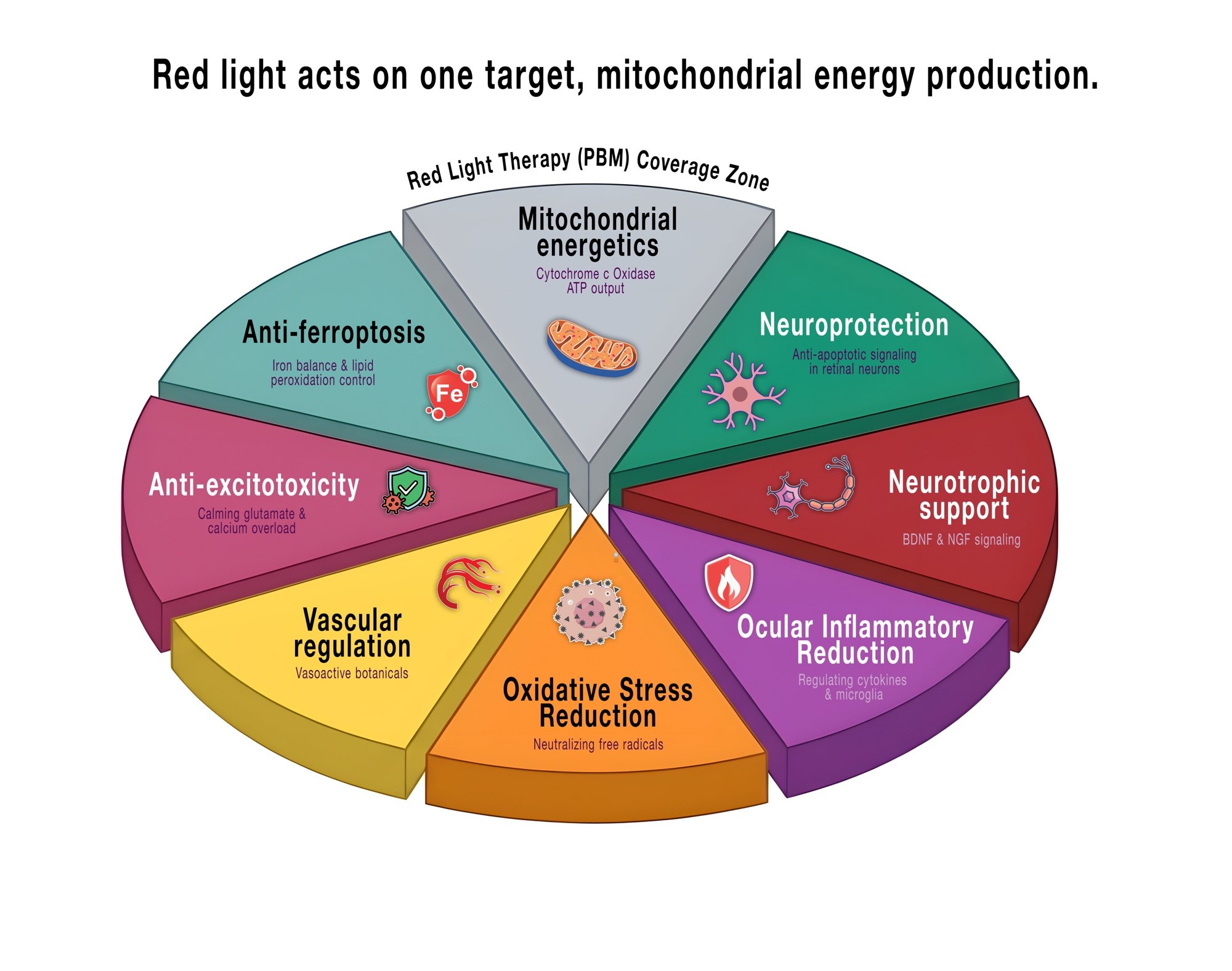
Figure 2: Full-spectrum ocular care. Photobiomodulation acts on mitochondrial energetics (grey). NRT's herbal medicines, supported by acupuncture, add vascular regulation, neurotrophic support, oxidative stress reduction, inflammation reduction, anti-ferroptosis, anti-excitotoxicity and neuroprotection.
Red light therapy (PBM): Measured doses of red and near-infrared light delivered to the retina
Netra Restoration Therapy (NRT): Individualized phytoceutical (herbal) program from TCM and Ayurvedic ophthalmology, supported by acupuncture
Red light therapy (PBM): Mitochondrial energy production
Netra Restoration Therapy (NRT): Blood flow, BDNF/NGF, inflammation, oxidative stress, ferroptosis, excitotoxicity, antioxidant supply, neuroprotection
Red light therapy (PBM): Through the pupil, as light
Netra Restoration Therapy (NRT): Through the bloodstream to the retina and choroid; circulation-improving herbs in the formula carry the other compounds, and acupuncture supports the response
Red light therapy (PBM): Randomized sham-controlled trial in early dry AMD; FDA-authorized device
Netra Restoration Therapy (NRT): Randomized placebo-controlled trials of botanicals: Ginkgo in normal-tension glaucoma, goji in RP, crocin in glaucoma
Red light therapy (PBM): One device, one protocol, tested
Netra Restoration Therapy (NRT): Complete combined program not yet tested in a controlled trial
Red light therapy (PBM): 9 sessions over 3 to 5 weeks, repeated every 4 months
Netra Restoration Therapy (NRT): Daily herbal formula over months, reviewed and adjusted; supportive acupuncture scheduled around it
Red light therapy (PBM): Same protocol for every eye
Netra Restoration Therapy (NRT): Yes: formula and supportive sessions chosen per patient
Red light therapy (PBM): Not applicable
Netra Restoration Therapy (NRT): Dry eye from long-term drops, ocular comfort, sleep, stress and circulation
Red light therapy (PBM): Adjunct
Netra Restoration Therapy (NRT): Adjunct
Red light therapy (PBM): Photosensitivity, photosensitizing drugs, light-triggered neurological disorders; home devices lack retinal dose control
Netra Restoration Therapy (NRT): Herb-drug interaction check (for example Ginkgo with blood thinners); clinic-specified preparations only; sterile single-use needles for supportive acupuncture; paused with active infection, recent surgery or uncontrolled inflammation
Ask of any therapy: which drivers of cell loss does it reach, and how was that shown?
Red light (PBM): Direct
NRT: Supportive
How NRT reaches it: Botanicals with mitochondrial and antioxidant activity (Lycium, saffron, Ginkgo); better perfusion delivers substrate
Red light (PBM): No
NRT: Yes
How NRT reaches it: Vasoactive botanicals: Ginkgo extract raised peripapillary and ophthalmic-artery blood flow and improved visual-field damage in randomized normal-tension glaucoma trials, and slowed field loss over 12 years in a retrospective series
Red light (PBM): No
NRT: Yes
How NRT reaches it: Neuroprotective botanicals (Lycium, saffron, Ginkgo) support BDNF and NGF survival signaling; BDNF restoration is a recognized neuroprotective strategy
Red light (PBM): Indirect
NRT: Yes
How NRT reaches it: Antioxidant botanicals: Lycium in a year-long placebo-controlled RP trial; crocin in a triple-blind glaucoma trial
Red light (PBM): Indirect
NRT: Yes
How NRT reaches it: Herbs inhibit NF-κB and MAPK, the switches that drive cytokine production; adaptogenic botanicals steady the autonomic signaling that disturbs ocular blood flow
Red light (PBM): No
NRT: Yes
How NRT reaches it: Ferroptosis-reducing botanicals for iron balance and lipid-peroxidation control; ferroptosis inhibition preserved ganglion cells in glaucoma models
Red light (PBM): No
NRT: Yes
How NRT reaches it: Botanicals (Ginkgo, crocin) proposed to calm glutamate and calcium overload in stressed neurons
Red light (PBM): No
NRT: Yes
How NRT reaches it: Anti-apoptotic botanicals (Lycium, crocin, resveratrol, curcumin) that help retinal neurons survive stress
Reading this comparison. It is a map of mechanisms, not a ranking of evidence. The targets are not equal in clinical weight, and “Yes” for NRT indicates that the formula includes botanicals with documented activity on that pathway, mostly from laboratory studies and from trials of single botanicals. It does not mean the full program has been proven to change that pathway in patients.
Often, yes. They are not rivals. Red light asks the mitochondria to make more energy. NRT's herbal formulas work to make sure the cell has the blood supply, the growth signals, the antioxidant reserves and the calm immune environment it needs to use that energy and survive.
Picture a struggling garden. Red light is a grow lamp: it helps plants that are already rooted make the most of the day. NRT is the soil, the water and the fence that keeps pests out. A grow lamp over depleted soil gives a brief flush of growth and then fades, which is exactly the pattern the small red light studies in retinitis pigmentosa reported.
If you are receiving prescription PBM for dry AMD, tell both teams. Your herbal formula and supportive acupuncture are scheduled around your light series, and your ophthalmologist's OCT, field and acuity tests become the shared scorecard.
The combination itself has not yet been studied. The case for pairing them rests on biology: the two approaches reach different targets, and neither undoes the other.
In fairness, the same scrutiny applies to our own program.
See also Ayurvedic eye treatment safety.
Bring your most recent OCT, visual field and eye-pressure results to your first NRT visit. Referrals are welcome after diagnosis and baseline management are established. To get started, see Am I a candidate? or request an appointment, or call (732) 503-9999 to speak with a patient care coordinator.
Netra Eye Institute · 5001 Hadley Rd, Ste 210, South Plainfield, NJ 07080 · Phone (732) 503-9999 · Fax (732) 333-6473
For one use, yes, modestly. A prescription clinic device improved vision by about 2.4 letters over sham in early-to-intermediate dry macular degeneration and is FDA-authorized for that. For other eye conditions the evidence is weak, mixed or negative.
The prescription dry-AMD device showed no phototoxicity in trials. Other devices are a different matter: retinal damage has been reported in a child using daily red light for myopia, and home devices do not control the dose reaching the retina.
It does not correct nearsightedness, farsightedness or astigmatism in adults. Small laboratory studies reported short-lived improvements in color contrast in older adults; these have not been consistently reproduced.
Yes, at the wrong dose. The retina can be injured by light. Never look into a laser or high-power LED, and wear the eye protection supplied with skin panels.
One prescription device received FDA marketing authorization in 2024 for improving vision in early-to-intermediate dry AMD. No home panel, mask, wand or pair of glasses is authorized for any eye disease.
There is no published controlled-trial evidence that consumer red light glasses treat any eye disease, and they are not FDA-authorized for one. They do not deliver a controlled retinal dose.
In early-to-intermediate dry AMD, a clinic-based multiwavelength treatment produced a small average gain in vision and fewer eyes progressing to geographic atrophy over two years. It is not a cure and is not for wet AMD.
No human trial has shown that it protects the optic nerve or slows glaucoma. It does not lower eye pressure. Evidence is limited to laboratory and animal studies.
In children, repeated low-level red light slows eye growth in trials, but there are safety concerns, including a reported case of retinal damage. It is not FDA-authorized. Discuss established myopia-control options with your eye doctor first.
Low-level light applied to the eyelids, usually together with intense pulsed light, has limited supportive evidence for meibomian gland dysfunction. That treats the lids, not the retina.
It is the medical term for using low-power red and near-infrared light to influence cell function, mainly by stimulating a mitochondrial enzyme. “Red light therapy” is the popular name.
Red light delivers light through the pupil to boost mitochondrial energy, with the same protocol for every eye. NRT is an individualized herbal program supported by acupuncture, delivered through the bloodstream and designed to act on blood flow, growth signals, inflammation, oxidative stress, ferroptosis, excitotoxicity and nerve-cell survival.
They are different tools. Red light has one sham-controlled device trial and reaches one main target. NRT addresses more disease drivers and draws on randomized trials of individual botanicals, but the complete program has not been tested in a controlled trial. No study has compared them head to head, and many patients can use both.
Often, yes, with both care teams informed. The combination has not been studied; the rationale is that the two reach different targets.
This article is general education and does not replace an individual eye examination. NRT is adjunctive to conventional ophthalmic care and is not presented as a cure. Individual results vary. Continue all prescribed treatment and monitoring with your ophthalmologist.