Search conditions, treatments, research reviews and articles. Press Enter to see all results, Esc to close.
Search conditions, treatments, research reviews and articles. Press Enter to see all results, Esc to close.
Blog
November 22, 2026
Kaleidoscope vision is usually a migraine aura lasting 20 to 30 minutes. Learn the causes, how to tell it from a stroke or TIA, and when to get help.
Key points
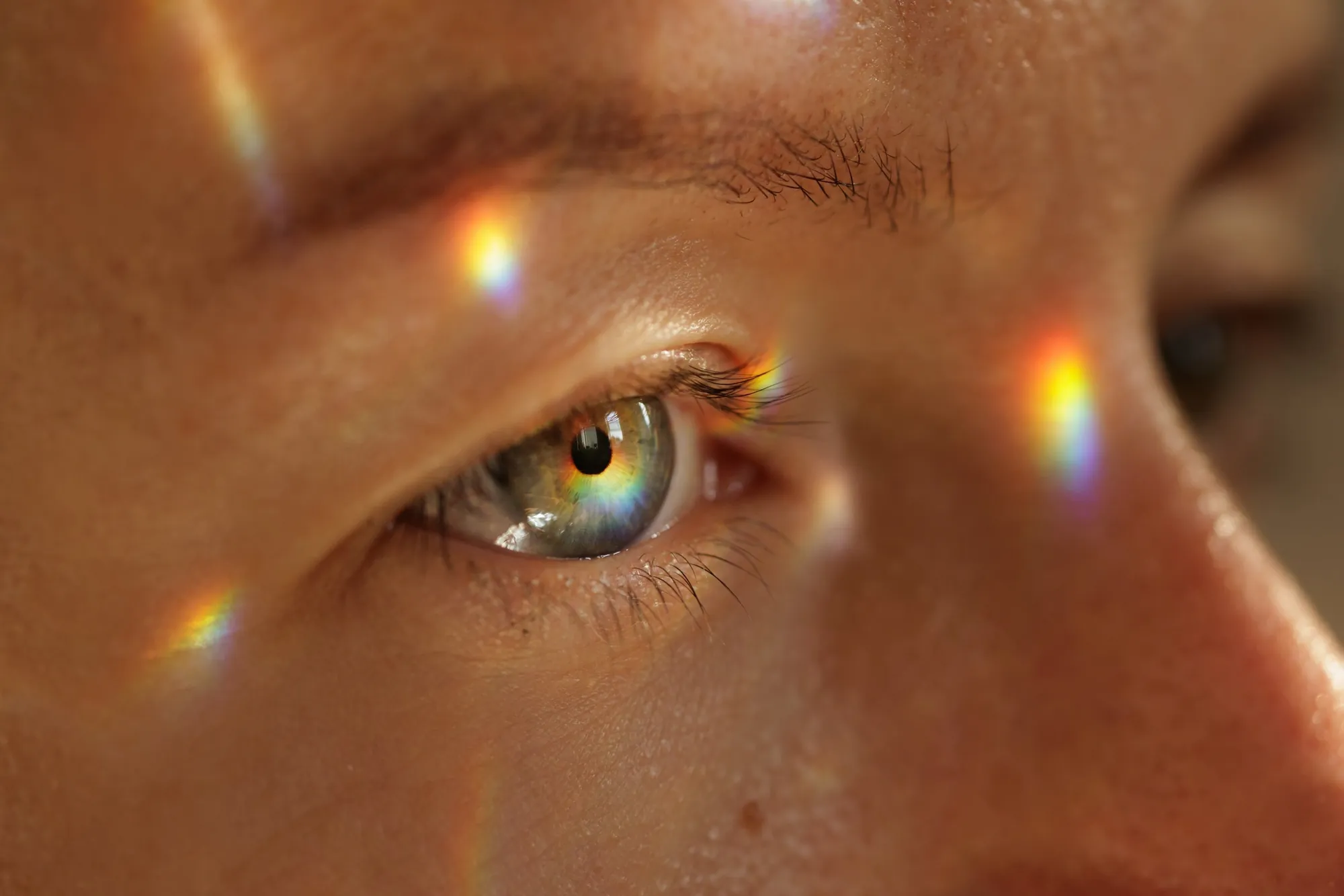
Kaleidoscope vision is a temporary visual disturbance in which part of what you see looks fractured, shimmering, brightly colored or broken into shifting geometric pieces, as if you were looking through a kaleidoscope. The most common cause by far is a migraine aura, which begins in the brain’s visual cortex, affects both eyes, builds over 5 to 20 minutes, and clears within an hour. It may or may not be followed by a headache. Less often, kaleidoscope-like symptoms come from a transient ischemic attack (TIA), stroke, retinal problems or seizures. A first episode, an episode lasting more than an hour, or one with weakness, numbness, speech difficulty or loss of vision needs urgent medical assessment.
Call emergency services if kaleidoscope vision comes with weakness or numbness on one side, a drooping face, slurred or confused speech, sudden severe headache, loss of balance, or loss of vision that does not return. Get same-day care if it is your first episode, it lasts longer than 60 minutes, it affects only one eye, you are over 50 with no history of migraine, or you see new floaters, flashes or a curtain afterwards.
People use many descriptions:
A typical episode runs like this. It starts small, near where you are looking. Over 5 to 20 minutes the shimmering arc expands and drifts toward one side of your vision. It then breaks up and fades at the edge. The whole event lasts 20 to 30 minutes on average and less than 60. Vision returns fully to normal.
It is present in both eyes at once and on the same side of the visual field. Many people believe it is in one eye, the eye on the side where they see it. If you cover each eye in turn, you will find it is visible with either eye. You can also see it with both eyes closed.
Migraine aura is produced by a wave of electrical activity called cortical spreading depression. A burst of activation in nerve cells, followed by a period of reduced activity, travels slowly across the surface of the brain at about 3 millimeters per minute.
When this wave crosses the visual cortex at the back of the brain, the leading edge of activation is perceived as shimmering light and geometric patterns. The quiet zone behind it is perceived as a blind patch. The slow speed of the wave explains why the visual disturbance expands and marches across your vision over many minutes. The zigzag pattern reflects how the visual cortex is organized to detect edges at different angles.
If the wave continues into neighboring areas, you may notice tingling that creeps from the hand up to the face, or difficulty finding words. These are sensory and language auras.
The headache phase that often follows involves a different system: activation of the trigeminal nerve and release of inflammatory messengers such as CGRP around the blood vessels of the brain’s coverings. See headache behind the eyes for the pain side of migraine.
One eye or both: Both
Onset and course: Gradual, expands and moves
Duration: 5 to 60 minutes
What you see: Shimmering zigzags, colors, blind patch
Other clues: Headache may follow; past similar episodes
One eye or both: Both
Onset and course: Same
Duration: 5 to 60 minutes
What you see: Same
Other clues: Common after 50 in people with past migraine
One eye or both: One
Onset and course: Gradual
Duration: Under 60 minutes
What you see: Flicker, dimming or blackout in one eye
Other clues: Rare; diagnosis of exclusion
One eye or both: Both, same side
Onset and course: Sudden
Duration: Minutes (TIA) or persistent (stroke)
What you see: Missing half of vision; rarely shimmer
Other clues: Vascular risk factors; other neurological signs
One eye or both: One
Onset and course: Sudden
Duration: Seconds to minutes
What you see: Curtain or blackout
Other clues: Emergency; stroke warning
One eye or both: One
Onset and course: Sudden
Duration: Seconds, repeated
What you see: Brief flashes at the edge, floaters, shadow
Other clues: Same-day care
One eye or both: One
Onset and course: Sudden
Duration: Seconds, repeated
What you see: Arc-like flashes at the side, new floater
Other clues: Examination needed
One eye or both: Both
Onset and course: Sudden
Duration: Seconds to a few minutes
What you see: Colored circles or balls, often multicolored
Other clues: May progress to other seizure signs
One eye or both: Both
Onset and course: Gradual
Duration: Minutes
What you see: Dimming, sparkles
Other clues: Light-headed, sweaty; resolves with food or sitting
One eye or both: Both
Onset and course: Variable
Duration: Variable
What you see: Geometric patterns, trails
Other clues: Hallucinogens, some medications
About a quarter to a third of people with migraine have aura with at least some attacks. Visual aura is by far the most common type, present in over 90% of those with aura.
Typical sequence
Common triggers
Not every trigger applies to every person, and triggers often need to combine before an attack occurs. A simple diary helps identify yours.
Aura can occur alone. This is sometimes called “ocular migraine,” “silent migraine” or “acephalgic migraine.” It is common: many people with migraine with aura have some attacks without pain, and with age the headache often fades while the aura continues.
In people over 50, new episodes of aura without headache have been called “late-life migraine accompaniments.” They are usually benign, but because TIA becomes more common at the same age, a first episode in later life should always be medically assessed. Features that favor migraine over TIA are the gradual build-up, the march across the visual field, positive visual phenomena, repeated identical episodes, and a duration of 15 to 25 minutes.
We explain the terminology, which is often used loosely, in ocular migraine, aura and retinal migraine.
True retinal migraine is rare. It causes repeated attacks of flickering, dimming or temporary blindness in one eye only, confirmed by covering each eye during an attack, with or followed by a migraine headache. It is thought to involve reduced blood flow in the retina.
Because temporary vision loss in one eye has other, more dangerous causes, including a clot from the carotid artery or heart, giant cell arteritis in people over 50, and intermittent angle closure, retinal migraine is only diagnosed after those have been excluded. If your symptoms are truly in one eye, get an urgent evaluation.
A transient ischemic attack is a brief interruption of blood flow to part of the brain or eye. Symptoms resolve, usually within minutes to an hour, but a TIA signals a high short-term risk of stroke.
Migraine aura: Gradual over 5 minutes or more
TIA or stroke: Sudden, maximal within seconds
Migraine aura: Marches across the field; symptoms follow one another
TIA or stroke: All symptoms at once
Migraine aura: Positive: shimmer, zigzags, colors, tingling
TIA or stroke: Negative: loss of vision, numbness, weakness
Migraine aura: Usually 20 to 30 minutes; under 60
TIA or stroke: TIA often under 15 minutes; stroke persists
Migraine aura: Often follows
TIA or stroke: Sometimes; not typical pattern
Migraine aura: Similar past episodes, often from young adulthood
TIA or stroke: Often first event; vascular risk factors
Migraine aura: Usually starts before 40
TIA or stroke: More common over 55
These are tendencies, not rules. Strokes can occasionally cause positive visual symptoms, and aura can occasionally be abrupt. That is why a first episode, an unusual episode, or any episode with weakness, numbness on one side, speech difficulty, confusion or lasting vision loss should be treated as an emergency. Use the BE-FAST check: Balance loss, Eyes (vision loss), Face drooping, Arm weakness, Speech difficulty, Time to call emergency services.
A stroke in the visual cortex typically causes loss of the same half of the visual field in both eyes. See homonymous hemianopia. A clot in the retinal artery causes sudden loss in one eye. See eye stroke: symptoms and treatment.
The retina responds to any stimulation, including mechanical tugging, by signaling light. Flashes from the eye differ from kaleidoscope vision:
Causes include:
Do not drive until your vision is fully back to normal.
Migraine with aura is diagnosed from your description. There is no scan or blood test that confirms it. The clinician’s job is to recognize the pattern and to rule out look-alikes when the story is not typical.
Questions you will be asked
Examination and tests
The aura itself has no proven quick treatment; it runs its course. Management focuses on the headache and on reducing how often attacks occur.
Acute treatment of the headache
Preventive options when attacks are frequent or disabling
Reducing stroke risk
Migraine with aura is associated with a roughly doubled risk of ischemic stroke. The absolute risk remains low for most people, but it rises substantially with smoking and with estrogen-containing contraceptives. Sensible steps:
Pregnancy. Hormonal change can bring out aura for the first time or alter existing migraine. New visual disturbances in the second half of pregnancy or soon after delivery, especially with headache, swelling or high blood pressure, can be a sign of preeclampsia and need same-day obstetric assessment.
Older adults. New aura without headache is common and usually benign, but stroke, TIA, giant cell arteritis and retinal detachment are also more common. Get a first episode checked.
Children and teenagers. Migraine with aura occurs in children. They may struggle to describe it. Some experience distortions of size and shape (“Alice in Wonderland” syndrome). A pediatrician should assess any visual disturbance in a child.
If your episodes recur, a short record helps your doctor confirm the pattern and find triggers. It also gives you a baseline, so that you can recognize an episode that is different.
For each episode, note
What the diary can show
Take the diary to a doctor promptly if
A phone note works well. Some people sketch what they see, which can be more useful than a description.
Netra Eye Institute does not diagnose the cause of visual disturbances. A first, prolonged or atypical episode belongs with a physician or emergency department. Once migraine with aura has been diagnosed and other causes excluded, integrative care can sit alongside your doctor’s plan.
Acupuncture for migraine prevention. This is one of the better-studied uses of acupuncture. A Cochrane review of 22 trials with nearly 5,000 participants concluded that adding a course of acupuncture to usual care reduces the frequency of episodic migraine, that true acupuncture has a small advantage over sham, and that it is similarly effective to preventive drug treatment with fewer adverse effects. A course of at least six sessions is typical. Learn about acupuncture at Netra.
When the retina or optic nerve is involved. Some people who look up kaleidoscope vision turn out to have a chronic eye condition in which shimmering and flickering are a daily feature, such as retinitis pigmentosa, macular degeneration, or recovery after a retinal vascular event. Others have migraine alongside normal-tension glaucoma. The two share features of vascular dysregulation (blood vessels that over-react to cold, stress and blood pressure dips), and several studies have found migraine to be a risk factor for progression in normal-tension glaucoma. See ocular blood flow and vascular dysregulation in glaucoma.
Netra Restoration Therapy (NRT) is our phytoceutical eye-care program for chronic retinal, optic nerve and corneal conditions. It uses individualized herbal formulas drawn from TCM ophthalmology and Ayurvedic ophthalmology, with acupuncture in a supportive role. It is designed to act on several disease drivers together: unstable ocular blood flow, loss of neurotrophic support, oxidative stress, low-grade inflammation, ferroptosis, mitochondrial stress and excitotoxicity.
What to keep in mind:
See what is Netra Restoration Therapy or call (732) 503-9999 if you have a diagnosed eye condition and want to know whether it is relevant.
It is a temporary visual disturbance in which part of your vision looks shimmering, fractured, colorful or broken into geometric pieces. It is usually a migraine aura.
The most common cause is migraine aura, a wave of electrical activity crossing the visual part of the brain. Less common causes include TIA or stroke, retinal problems, seizures, low blood sugar and certain drugs.
Not usually, if it matches your past migraine auras and clears within an hour. It is an emergency if it is your first episode with other neurological symptoms, starts suddenly, lasts more than an hour, affects one eye only, or comes with weakness, numbness, speech trouble or vision loss.
A migraine aura typically lasts 20 to 30 minutes and no more than 60 minutes. Symptoms lasting longer should be medically assessed.
Yes. Aura without headache is common, particularly in people over 50 and in those with a past history of migraine.
Rarely. Stroke symptoms usually begin suddenly and involve loss of vision or function. Aura builds gradually and involves shimmering or patterns. Because the two can overlap, a first or unusual episode should be checked urgently.
Stress, and the relaxation after stress, are among the most common migraine triggers and can bring on an aura.
Both can trigger migraine aura. They can also cause sparkles or dimming with light-headedness that resolve with fluids, food or sitting down.
Very high blood pressure can cause visual disturbances and headache and needs urgent care. Ordinary high blood pressure does not typically cause aura, but it raises stroke risk and should be controlled.
Migraine aura is in both eyes, on the same side of the visual field. Cover each eye to check. A disturbance truly in one eye needs an urgent eye examination.
No. Pull over safely and wait until your vision is completely normal.
There is no proven way to stop an aura once it starts. Rest in a quiet, dim place, hydrate, and treat the headache early if one follows. Prevention through trigger management and, if needed, preventive treatment reduces how often it occurs.
For a first episode, an eye examination is a sensible start to rule out retinal causes, alongside your primary care doctor. Recurrent typical aura is managed by primary care or neurology.
This article is general education and does not replace an individual medical or eye examination. Sudden visual or neurological symptoms need emergency care. Integrative care should never delay medical assessment. Netra Restoration Therapy is adjunctive to conventional ophthalmic care and is not presented as a cure. Individual results vary.