
Search conditions, treatments, research reviews and articles. Press Enter to see all results, Esc to close.
Search conditions, treatments, research reviews and articles. Press Enter to see all results, Esc to close.
Blog
November 26, 2026
Narrow-angle glaucoma means the iris sits close enough to the eye's drain to block it. Here is how serious it is, what causes it, what to avoid and how eye surgeons fix it.
Key points
Narrow-angle glaucoma is glaucoma caused by a drainage angle that is too tight. The iris, the colored part of the eye, sits so close to the eye's drain that it can block fluid from leaving, and pressure inside the eye rises. It is the same condition as angle-closure or closed-angle glaucoma, and it accounts for about 10% of glaucoma in the United States.
Most people learn about it at a routine eye exam, with no symptoms at all. A smaller number find out during a sudden, painful attack. This page explains what the finding means, how serious it is, what to avoid and how it is fixed.
Having symptoms right now? Sudden severe eye pain, a red eye, blurred vision or rainbow halos around lights, with headache, nausea or vomiting, is an emergency. Go to an emergency department now and do not drive yourself. Our guide to an acute angle-closure attack covers what to do first.
Fluid called aqueous humor is made behind the iris, flows forward through the pupil and drains out where the iris meets the cornea. That meeting point is the drainage angle. In most eyes it is wide open. In some it is narrow, and the edge of the iris can press against the drain.
Three terms get used as if they mean the same thing. They do not.
If your eye doctor said you have "narrow angles," ask which of the three applies to you. The answer changes how urgent treatment is.
It depends on the stage. Narrow angles on their own are common and often never cause harm. In the Zhongshan Angle Closure Prevention trial, 889 adults aged 50 to 70 with narrow angles were followed for six years. Untreated eyes developed angle closure at a rate of about 8 per 1,000 eyes per year. The risk was real but low.
The serious outcomes are two:
Vision lost to glaucoma does not come back, so the goal is to find and treat the angle before the nerve is harmed. An eye that has already had an attack puts the other eye at much higher risk, and that second eye needs to be checked promptly.
Usually there are none. Narrow angles and slow angle closure cannot be felt.
Some people have short warning episodes, often in the evening or in a dark room: blurred vision, halos around lights, an ache over the brow or mild eye pain that clears in bright light or after sleep. These episodes can mean the angle is closing on and off. Report them to an eye doctor within days, not at your next yearly visit.
An acute attack looks different:
That combination needs emergency care immediately, even if the pain eases.
The shape of the eye. The most common mechanism is called pupillary block. In a small, crowded eye the lens sits close behind the iris. Fluid has trouble passing through the pupil, pressure builds behind the iris, and the iris bows forward against the drain.
The lens keeps growing throughout life, so an angle that was open at 40 can be narrow at 65. That is why the condition shows up mostly after 50.
You are more likely to have narrow angles if you:
Less common causes include plateau iris, where the structure behind the iris pushes its edge forward, a swollen cataract, inflammation inside the eye, abnormal new blood vessels from diabetes or a vein blockage, and reactions to certain medicines.
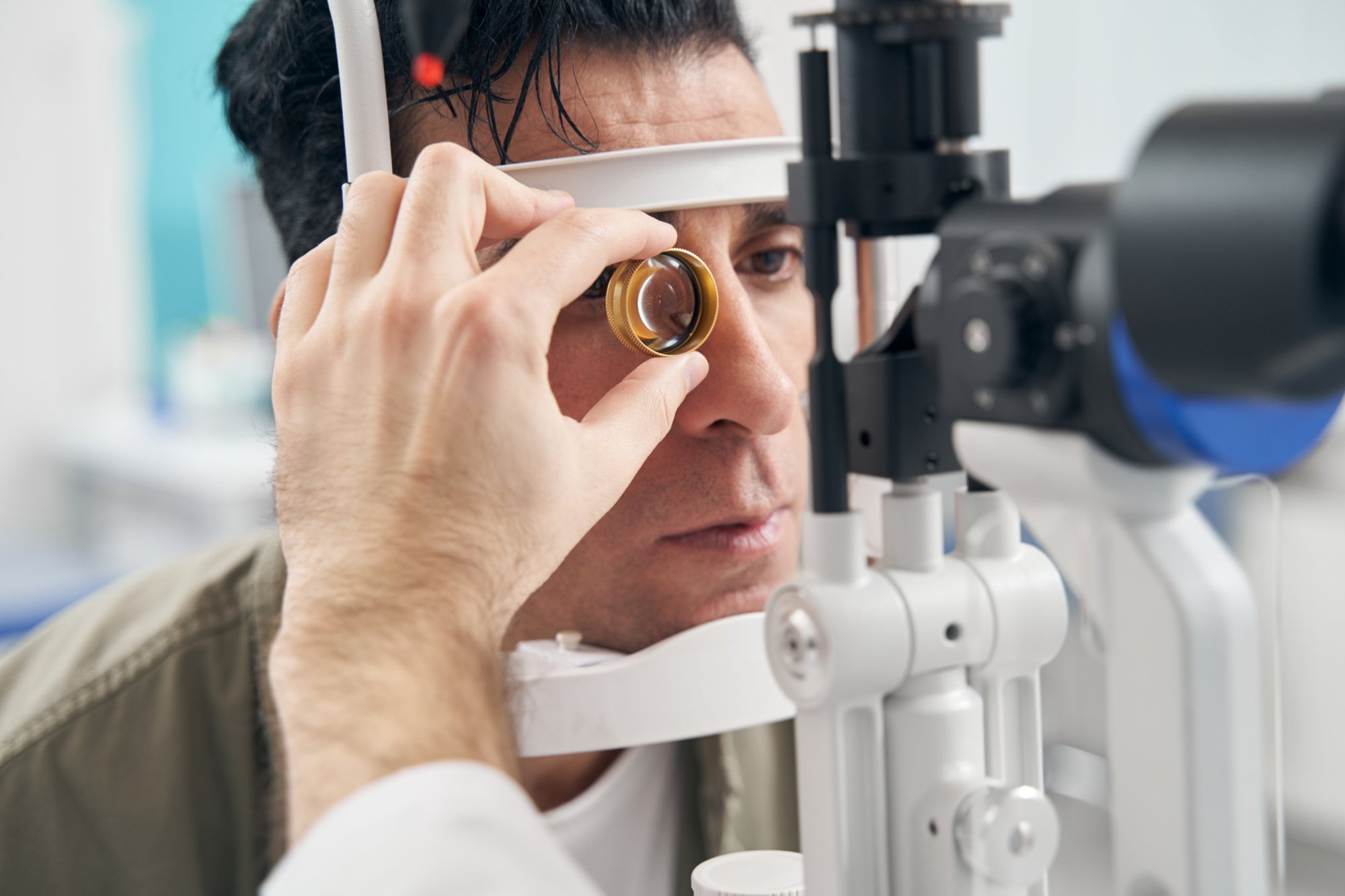
The test is gonioscopy. After numbing drops, the eye doctor rests a small mirrored lens on the eye and looks straight at the drainage angle. It takes a minute or two and does not hurt.
A pressure reading or an air-puff test cannot show whether an angle is narrow. Pressure is often normal between episodes. Imaging of the front of the eye (anterior-segment OCT or ultrasound) can add detail, and an optic nerve scan and visual field test show whether any glaucoma damage has occurred.
Treatment is done by an ophthalmologist, often a glaucoma specialist. The options are:
Laser and lens surgery fix the plumbing. They do not restore optic nerve that has already been lost, so people with glaucoma damage still need pressure checks and visual field tests for life.
The main concern is anything that widens the pupil in an eye whose angle has not yet been treated.
Once an iridotomy is open or the lens has been removed, most of these medicine restrictions no longer apply. Confirm that with your ophthalmologist, because a few mechanisms are not protected by laser.
No. Netra Eye Institute does not treat narrow angles, angle closure or an acute attack. Our clinic provides acupuncture-based care, not laser or surgery, and nothing we offer can open a drainage angle or lower pressure in an emergency. If you have been told you have narrow angles, the right next step is an ophthalmologist who performs gonioscopy and laser iridotomy. New Jersey residents can ask their optometrist for a referral to a glaucoma specialist.
We wrote this page because many people searching for narrow-angle glaucoma are trying to work out what kind of glaucoma they have and who should treat it.
Where we may be relevant is later, and for a different problem. Some people whose angles have been treated, and many people with open-angle or normal-tension glaucoma, are left with optic nerve damage and vision loss that continues to affect daily life. For those patients, with the ophthalmologist's care continuing unchanged, we offer Netra Restoration Therapy as an adjunct. It does not replace drops, laser or surgery.
Yes. Narrow-angle, closed-angle and angle-closure glaucoma are names for the same condition. "Narrow angles" alone means the anatomy is tight but no damage has happened yet.
The blockage can often be fixed with laser iridotomy or lens removal, which greatly lowers the chance of an attack. Nerve damage that has already occurred is permanent, and some people still need drops afterward.
Eye shape runs in families, so risk does too. If a close relative had angle closure, ask for gonioscopy at your next exam. See whether glaucoma is hereditary.
Tell the eye doctor before drops go in. They can check the angle first and decide whether dilation is safe or whether laser should come first. Do not skip retinal exams you need because of this worry.
Numbing drops are used. Most people feel a brief pinch or ache. Blurred vision for a few hours is common, and a small number of people notice glare or a faint line of light afterward.
It can if an acute attack is not treated quickly or if slow closure goes undetected for years. Found early and treated, most people keep their vision.
In open-angle glaucoma the drain looks open but works poorly, and damage is slow. In narrow-angle glaucoma the drain is physically covered by the iris. Treatment differs: open-angle glaucoma is managed mainly with drops and other laser types, while narrow angles are treated by opening the angle. More in glaucoma warning signs by type.
Medical Disclaimer: This article is general education, not personal medical advice. Sudden severe eye pain, redness, blurred vision or halos with headache, nausea or vomiting requires immediate emergency evaluation. Netra Eye Institute does not treat narrow angles or angle closure; that care is provided by an ophthalmologist.