Search conditions, treatments, research reviews and articles. Press Enter to see all results, Esc to close.
Search conditions, treatments, research reviews and articles. Press Enter to see all results, Esc to close.

Blog
October 31, 2026
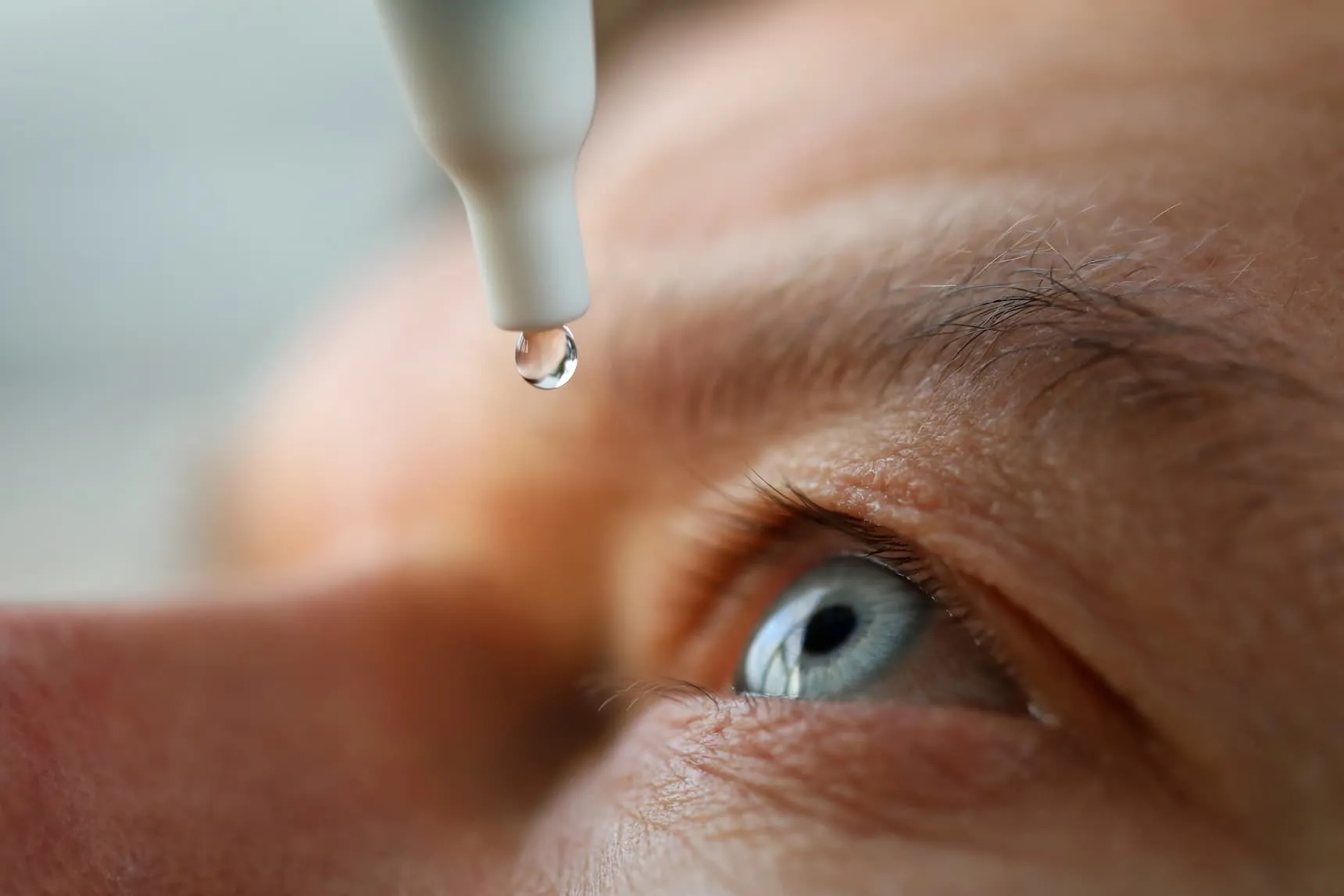
To use glaucoma eye drops, wash your hands, tilt your head back and pull down your lower eyelid to make a small pocket. Let one drop fall into the pocket without the bottle tip touching your eye. Then close your eye and press lightly on the inner corner for at least 1 minute, and wait at least 5 minutes before any other eye drop [1].
The rest of the routine matters too: steady timing, a plan for missed doses and correct storage. This how-to guide is the hands-on companion to our overview of glaucoma eye drop types, list and side effects.
This article is general education, not personal medical advice. Your own prescription label and your eye doctor's instructions come first. Do not stop or change a glaucoma medicine without talking to the doctor who prescribed it.
Key takeaways
In this article
Most drop problems can wait for a call to your eye doctor. Some cannot. Eye drops can reach the bloodstream, and beta-blocker drops such as timolol can affect breathing and heart rate [5,6]. Sudden severe eye pain or vision loss can signal acute angle-closure glaucoma [12].
Call 911 if, after using an eye drop, someone has:
Call Poison Control at 1-800-222-1222 if: a child swallows eye drops or someone uses far too much. Brimonidine (Alphagan P) is not for children under 2, and infants exposed to it have had slowed breathing and extreme sleepiness [14,15]. Call 911 instead if the child is hard to wake or breathing slowly.
Go to the emergency room now for: sudden, severe pain in one eye with blurred vision, rainbow halos, a red eye, nausea or vomiting, or a sudden loss of vision. These can be signs of acute angle-closure glaucoma [12].
Call your eye doctor the same day for: eye or eyelid redness that keeps getting worse, eyelid swelling, new light sensitivity, or a change in your vision [4].
The goal is one drop in the pocket of your lower eyelid, a clean bottle tip, and a closed eye for a minute or more. These steps combine National Eye Institute, MedlinePlus and drug label guidance. Ask your clinic to watch you do it with your own bottle [1,4,6].
If a drop clearly misses your eye, put in one more [6]. If you are often unsure, lie flat, ask someone to watch, or ask about an eye drop aid. Do not keep adding drops "just in case." Extra liquid runs out of the eye, and the bottle runs out early [3].
Prostaglandin drops can darken the skin around the eye and make lashes longer and darker [4]. In a small trial, wiping away extra liquid after each drop was linked to less darkening of the eyelid skin near the nose. The evidence is weak, but wiping is easy [17].
Punctal occlusion means pressing gently on the inner corner of your closed eye, over the tear drain, after a drop. In a small study, pressing the tear drain and keeping the eye closed cut the amount of timolol reaching the blood by more than 60%. Its effect on eye pressure itself is less certain [5,17].
The tear drain, called a punctum, is a tiny opening at the inner corner of the eyelid. Medicine that flows down it reaches the nose and then the blood. That is how eye drops cause effects elsewhere, such as a slower heart rate from timolol [1,6].
Punctal occlusion is safe and simple [5]. It may matter most for drops with whole-body side effects, such as beta blockers. Press beside the eye at the inner corner, not on the eyeball.
Wait at least 5 minutes between different eye drops. Some labels ask for 10 minutes, including Timoptic and Azopt. With the gel-forming Timoptic-XE, put your other drops in at least 10 minutes before it. Waiting stops the second drop from washing out the first [1,6,7,16].
An example, for illustration only: latanoprost at 9:00 p.m., then timolol at 9:10 p.m. Your own order and times should come from your prescriber or pharmacist.
Follow the times on your label. Once-daily prostaglandin drops such as latanoprost, and netarsudil (Rhopressa), are labeled for the evening. Twice-daily drops are used morning and evening, and brimonidine three times a day about 8 hours apart. Choose fixed times that fit your day [8,15,20,21].
In a 6-month trial, evening latanoprost lowered daytime eye pressure by 35%, compared with 31% for morning use [22]. If evenings are hard, ask whether another time is acceptable rather than skipping doses. Do not use a prostaglandin more than once a day. Labels warn that extra doses may weaken its effect [8,9,10].
For a once-daily evening drop such as latanoprost, skip the missed dose and use the next one at the usual time. For a twice-daily drop, use the missed dose when you remember, unless the next dose is almost due. Never use a double dose to catch up [4,8,14].
Drops control glaucoma but do not cure it, so they work only while you keep using them [4]. Repeated gaps matter. In a 2026 study of more than 8,000 patients, people who refilled their drops less reliably had higher eye pressure and faster visual field loss [25]. If you often miss doses or cannot afford a refill, tell your eye doctor. Our guide to eye pressure readings explains why steady control matters.
Store each bottle exactly as its label says, because the rules differ. Unopened Xalatan (latanoprost) and Zioptan (tafluprost) belong in the refrigerator, while Lumigan, Travatan Z and many others can stay at room temperature. Keep all drops away from heat, freezing and children [8,9,10,26].
The table summarizes label instructions for common brands, checked in October 2026. Generic versions can have different storage rules, so your own label always wins.
| Brand (medicine) | Label schedule | Wait before other drops | Storage on the label |
|---|---|---|---|
| Xalatan (latanoprost) | Once daily, evening | 5 minutes | Unopened: refrigerator, 36–46°F. Opened: up to 77°F for 6 weeks [8] |
| Iyuzeh (latanoprost, preservative-free) | Once daily, evening | 5 minutes | 59–77°F; vials good for 30 days after the pouch is opened [23] |
| Zioptan (tafluprost, preservative-free) | Once daily, evening | 5 minutes | Unopened pouches: refrigerator. Opened pouch: room temperature up to 30 days [26] |
| Lumigan (bimatoprost) | Once daily, evening | 5 minutes | 36–77°F [9] |
| Travatan Z (travoprost) | Once daily, evening | 5 minutes | 36–77°F [10] |
| Vyzulta (latanoprostene bunod) | Once daily, evening | 5 minutes | Unopened: refrigerator. Opened: 36–77°F for 8 weeks [27] |
| Rhopressa (netarsudil) | Once daily, evening | 5 minutes | Refrigerator until opened, then 36–77°F for up to 6 weeks [20] |
| Timoptic (timolol) | Usually twice daily | 10 minutes | 59–77°F, stored upright; do not freeze [6] |
| Timoptic-XE (timolol gel) | Once daily | Other drops at least 10 minutes before it | 59–77°F; avoid freezing [16] |
| Azopt (brinzolamide) | Three times daily; shake well | 10 minutes | 39–86°F [7] |
| Alphagan P (brimonidine) | Three times daily, about 8 hours apart | 5 minutes | 59–77°F [15] |
| Cosopt PF (dorzolamide-timolol, preservative-free) | Twice daily | 5 minutes | 68–77°F; throw away vials 15 days after opening the pouch [21] |
Tie each dose to a habit you already have, set a phone alarm, and tick off each dose on a chart. Refill before the bottle runs out. If side effects, cost or a hard-to-squeeze bottle get in the way, tell your eye doctor, because those problems usually have solutions [28,29].
Missed doses are common. In a US study of 196 patients using an electronic dosing aid, people took 71% of their doses on average, and about 45% took fewer than 75%. Patients guessed they took 95%, and their doctors were poor at telling who was missing doses [11].
Help can work. In a randomized trial, education, problem-solving, phone reminders and device alarms raised dose-taking from 54% to 73% over three months. This was in people who had been missing doses [29]. A Cochrane review found that education plus tailored support may help, but no single method is proven best [28].
Ask about an eye drop aid, a small device that holds the bottle in position over the eye. In a study of 30 people with low vision, a nose-pivoted aid raised successful drops from 52% to 76% of eyes. It also cut bottle-tip contact from 40% to 14% [31].
Drop problems are common even in experienced users. When 139 patients were filmed, only 22% to 31% placed a single drop without the bottle touching the eye or lids [32]. In another study, people who could not reliably get drops in were more likely to have glaucoma progression or need surgery over about five years [33]. That shows a link, not proof of cause, but it is a good reason to have your technique checked.
Our guide to living with low vision covers lighting, magnifiers and other daily tools.
Netra Restoration Therapy (NRT) is an integrative program used alongside, not instead of, care from your eye doctor. NRT does not lower eye pressure and does not replace glaucoma drops, laser or surgery. It has not been tested in controlled trials for glaucoma.
If you use NRT or any other complementary care, keep every glaucoma drop on its usual schedule and keep your pressure and visual field checks. Never put herbal, homemade or other non-sterile liquids into the eye. Read about how NRT effectiveness should be judged.
Keep your eye gently closed for at least 1 minute, and up to 2 to 3 minutes, while pressing lightly on the inner corner. Try not to blink hard or squeeze your lids. This keeps more medicine in the eye and less draining into your nose and bloodstream.
No. One drop is the dose for most glaucoma medicines, and a single drop already holds more liquid than the eye needs. Extra drops run onto your cheek and empty the bottle early. If a drop clearly missed your eye, put in one more.
Unopened bottles of Xalatan (latanoprost) should be kept in the refrigerator. Once opened, a bottle can be kept at room temperature up to 77°F (25°C) for 6 weeks. Some other latanoprost products, such as Xelpros and Iyuzeh, are stored at room temperature, so check your own label.
Take your contact lenses out first. Most glaucoma drop labels say to wait 15 minutes before putting lenses back in, partly because the preservative BAK can be absorbed by soft lenses.
The full pressure-lowering effect can take a few weeks to settle. For timolol, the label advises checking eye pressure after about 4 weeks of treatment. You will not feel the drops working, so keep using them as prescribed.
Yes, use them at your usual times unless your clinic tells you otherwise. Do not add extra doses before a visit. Tell your doctor honestly about missed doses, because a good reading on the day can hide gaps at home.
Drops control glaucoma but do not cure it, so most people need treatment long term. Some people can use fewer drops, or none for a time, after laser treatment. Never stop on your own, even when your eyes feel fine.
Sources checked October 31, 2026.
This article provides general education and does not replace an individual eye examination, diagnosis or treatment plan. Sudden severe eye pain, sudden vision loss, or trouble breathing after an eye drop needs emergency care right away.