Search conditions, treatments, research reviews and articles. Press Enter to see all results, Esc to close.
Search conditions, treatments, research reviews and articles. Press Enter to see all results, Esc to close.

Blog
October 24, 2026
There are two main types of glaucoma: open-angle glaucoma and angle-closure glaucoma, which is also called closed-angle or narrow-angle glaucoma. The difference lies in the drainage angle, the spot where fluid leaves the eye. In open-angle glaucoma the angle stays open but drains too slowly, so pressure creeps up and vision is lost slowly and painlessly. In angle-closure glaucoma the iris blocks the angle; a sudden attack is painful and needs emergency care. Open-angle is by far the most common type: about 9 in 10 people with glaucoma in the United States have it. Other forms include normal-tension glaucoma, secondary glaucomas caused by another condition or medicine, and glaucoma in babies and children. This page explains each type, how they differ and which are the most serious.
For the condition as a whole, including the types, symptoms, who is at risk, how it is diagnosed, today’s treatments and the trials testing nerve protection, read our glaucoma guide.
Doctors sort glaucoma first by whether the drainage angle is open or closed, and then by whether the cause is unknown (primary glaucoma) or known (secondary glaucoma). About 4.2 million people in the United States were living with glaucoma in 2022. The table sums up the forms you are most likely to hear about.
| Type | What happens and who it affects |
|---|---|
| Primary open-angle glaucoma | The drainage angle is open, but fluid drains too slowly through the spongy drainage tissue, so pressure slowly rises. The most common type, with about 9 in 10 US cases. No early symptoms; side vision fades first. |
| Acute angle-closure glaucoma | The outer edge of the iris blocks the drainage angle and pressure rises fast. Causes sudden severe eye pain, a red eye, blurred vision, halos, headache and nausea. A medical emergency. |
| Chronic angle-closure glaucoma | The angle closes gradually and pressure rises slowly. Often causes no symptoms, like open-angle glaucoma. |
| Normal-tension glaucoma | A form of open-angle glaucoma with optic nerve damage at normal eye pressure. More common in people of Japanese ancestry and linked to low blood pressure and some heart rhythm problems. |
| Pigmentary glaucoma | Pigment flakes off the back of the iris and clogs the drain. Most often found in nearsighted men and usually diagnosed between ages 30 and 50. Vision can blur, or halos can appear, after exercise. |
| Exfoliation (pseudoexfoliation) glaucoma | Extra material builds up on parts of the eye and blocks drainage. It often causes higher pressure and can progress faster than primary open-angle glaucoma. |
| Neovascular glaucoma | Abnormal new blood vessels grow over the drain, usually because of diabetic eye disease or a blocked retinal vein. Hard to treat. |
| Uveitic glaucoma | Inflammation inside the eye (uveitis) blocks drainage, and the steroids used to treat it can add to the problem. About 2 in 10 people with uveitis develop it. |
| Steroid-induced glaucoma | Steroid medicines raise eye pressure in some people, especially eye drops and injections or implants in or around the eye. Pressure often improves once the steroid is reduced or stopped, but long-lasting high pressure can cause permanent damage. |
| Traumatic glaucoma | Caused by an eye injury. Pressure can rise straight away, often because of bleeding inside the eye, or years later, most often because the injury tore part of the drainage angle (angle recession). |
| Congenital and childhood glaucoma | Present at birth or starting in childhood. Babies may have cloudy, enlarged eyes, extra tears and sensitivity to light. Usually treated with surgery. |
The drainage angle is where the iris, the colored part of the eye, meets the cornea. Fluid made inside the eye leaves through spongy tissue in this angle called the trabecular meshwork. The Glaucoma Research Foundation compares open-angle glaucoma to a clogged pipe below a sink: the drain opening is clear, but fluid backs up further in. In angle-closure glaucoma, the iris itself covers the drain.
| Question | Open-angle vs angle-closure |
|---|---|
| What blocks drainage | Open-angle: resistance in the drainage tissue, even though the angle is open. Angle-closure: the edge of the iris covers the angle, most often because fluid is trapped behind the iris (pupillary block). |
| How common in the US | Open-angle: about 9 in 10 cases. Angle-closure: much less common. |
| How fast it happens | Open-angle: slowly, over months to years. Angle-closure: in an acute attack, pressure rises suddenly. Chronic angle closure develops slowly. |
| Symptoms | Open-angle: none early. Side vision is lost first, and most people don’t notice. Angle-closure: an acute attack causes severe eye pain, redness, blurred vision, rainbow halos, headache, nausea and vomiting. The chronic form often has no symptoms. |
| Is it an emergency? | Open-angle: no, but it needs lifelong treatment and checks. Angle-closure: an acute attack is an emergency. Without treatment it can cause blindness in a few days. |
| Who is most at risk | Open-angle: people over 60, African Americans over 40, people with a family history, and people who are nearsighted. Angle-closure: older adults, women, people of Asian or Inuit ancestry, farsighted people with small eyes, and people with a family history. |
| Main treatment | Open-angle: eye drops or laser (SLT), with surgery if needed. Angle-closure: laser iridotomy to open a new path for fluid, or lens removal in some eyes. An attack first needs urgent medicine to bring the pressure down. |
Primary open-angle glaucoma is a lifelong condition and the type most people mean when they talk about glaucoma. Because it is painless and side vision fades slowly, about half of people with glaucoma don’t know they have it. Risk is higher if you are over 60, especially if you are Hispanic or Latino, if you are African American and over 40, or if you have a family history of glaucoma. Nearsightedness, a thin cornea, diabetes and high blood pressure are also linked to higher risk.
Treatment usually starts with eye drops or selective laser trabeculoplasty (SLT). In the LiGHT trial, about 3 in 4 people treated first with SLT needed no drops to stay at their target pressure three years later. Our guides to glaucoma eye drops and glaucoma surgery and laser cover the options.
Angle-closure glaucoma happens when the iris is pushed against the drain, most often because fluid gets trapped behind it. In an acute attack the pressure rises suddenly. The National Eye Institute says that without treatment, angle-closure glaucoma can cause blindness in just a few days, and the Glaucoma Research Foundation warns that permanent damage can follow if the pressure is not lowered within hours. Go to an eye doctor or an emergency room right away if you suddenly have intense eye pain, a red eye or blurry vision, especially with halos around lights, headache, nausea or vomiting.
Many people have the slower, chronic form instead, which often has no symptoms and is found at an eye exam. The usual treatment is laser peripheral iridotomy, which makes a tiny opening in the iris so fluid can flow to the drain again. After an attack, the other eye has a high chance of one too (40% to 80% within 5 to 10 years, according to StatPearls), so both eyes are usually treated. In some eyes, removing the lens works better. The EAGLE trial included people aged 50 or older who had angle-closure glaucoma, or angle closure with very high pressure, and no cataract. In that trial, removing the clear lens worked better and was more cost-effective than laser iridotomy with eye drops. Our guide to angle-closure glaucoma covers narrow angles, attacks and treatment in detail.
Normal-tension glaucoma, also called low-tension or normal-pressure glaucoma, is a type of open-angle glaucoma in which the optic nerve is damaged even though eye pressure is in the normal range. StatPearls estimates that in people of white European ancestry, about one-third of open-angle glaucoma is the normal-tension type, and in East Asian countries it makes up most cases, up to 95%. In a large population study in Tajimi, Japan, 92% of people with open-angle glaucoma had pressure of 21 mmHg or less. Experts still debate whether it is a separate disease or a form of primary open-angle glaucoma.
The National Eye Institute lists Japanese ancestry, a family history of normal-tension glaucoma, low blood pressure and some heart problems, such as an irregular heartbeat, as risk factors. Migraine and Raynaud’s phenomenon have also been linked to it.
Lowering the pressure further still helps. The Collaborative Normal-Tension Glaucoma Study included eyes that were getting worse or had damage close to the center of vision. In those eyes, lowering the pressure by 30% slowed the disease, although the benefit only showed up after the researchers took into account cataracts, which were more common in eyes that had glaucoma surgery. Not every case gets worse quickly: in a later report from the same study, about one-third of untreated people got worse within 3 years and about half within 5 to 7 years. Read more on our normal-tension glaucoma page.
Secondary glaucoma is caused by another eye problem, a medical condition or a medicine. It can be open-angle or angle-closure and can affect one or both eyes. Treating the cause may help, but the pressure often needs treatment as well.
In pigment dispersion syndrome, pigment rubs off the back of the iris and drifts into the drain. Some people with it go on to develop pigmentary glaucoma: in one set of studies, about 10% did within five years and 15% within 15 years, and other studies report higher lifetime risks. It is most often found in nearsighted men and is usually diagnosed between ages 30 and 50. Exercise can push the pressure up, causing blurred vision or rainbow-colored rings around lights.
Exfoliation syndrome, also called pseudoexfoliation, deposits extra material on parts of the eye that can block drainage. According to the Glaucoma Research Foundation, exfoliation glaucoma is the most common identifiable secondary form of open-angle glaucoma in the world, and people with exfoliation syndrome are about six times as likely to develop glaucoma. It is more common in people of Nordic, Russian, Greek and other Mediterranean descent and in people from India. The National Eye Institute notes that it often causes higher pressure and can progress faster than primary open-angle glaucoma.
In neovascular glaucoma, the eye grows abnormal new blood vessels that cover the drain. It never occurs on its own. The most common causes are diabetic retinopathy, a blocked central retinal vein and poor blood flow to the eye (ocular ischemic syndrome). It is often hard to control, and the outlook for vision is usually poor, which is one more reason for people with diabetes to keep up their eye exams.
Uveitis is inflammation inside the eye, and about 2 in 10 people with it develop uveitic glaucoma, often because inflammatory debris clogs the drain. The steroids used to treat uveitis can also cause or worsen the glaucoma. Laser treatment is usually avoided because it can add to the inflammation.
Steroid medicines raise eye pressure in some people, especially when they are used as eye drops or given by injection or implant in or around the eye. About 4% to 6% of people are high responders, with large rises in pressure. The pressure often improves once the steroid is reduced or stopped, but prolonged or severe rises can damage the optic nerve for good. Never stop a prescribed steroid on your own; your doctors need to plan any change together.
An eye injury can cause glaucoma right away or many years later. The most common long-term cause is angle recession, a tear in the tissue at the drainage angle. This is one reason to wear safety glasses or goggles for sports and work that put your eyes at risk.
An advanced cataract can swell or leak and cause a painful rise in pressure that looks like an angle-closure attack. Removing the cataract is the definitive treatment, and when it is done promptly the pressure usually comes down within hours to days. Our guide to glaucoma vs cataracts explains how the two conditions affect each other.
Congenital glaucoma affects about 1 in 10,000 babies born in the United States, and most cases are diagnosed in the first year of life. Signs include cloudy eyes, eyes that look larger than normal, extra tears and sensitivity to light. The National Eye Institute says surgery works very well, and babies who have surgery early enough usually avoid permanent vision loss. The usual operations, goniotomy and trabeculotomy, open up the drainage tissue.
Juvenile open-angle glaucoma starts later in childhood or in early adulthood. Definitions vary, but it is usually described as starting between about age 3 and age 40. It affects about 1 in 50,000 people, tends to come with higher pressure and more severe field loss than adult glaucoma, and often runs in families: 10% to 33% of people with it carry a variant in the MYOC gene. Older children usually have no symptoms, so family screening matters.
Children who have cataract surgery can develop glaucoma later. Estimates vary with age at surgery and length of follow-up: the Glaucoma Research Foundation puts it at about 6% of children who have surgery for cataracts they were born with, while in the Infant Aphakia Treatment Study, the risk after surgery in infancy reached 22% by 10 years. These children need pressure checks for life.
You may hear two other terms at an eye exam. Ocular hypertension means eye pressure above the normal range, roughly 21 mmHg, with a healthy optic nerve. It is a risk factor, not glaucoma. In the Ocular Hypertension Treatment Study, about 2% of untreated people with high eye pressure developed glaucoma each year, or about 1 in 10 over five years, and pressure-lowering drops cut that five-year risk from 9.5% to 4.4%.
A glaucoma suspect is someone with risk factors, such as high pressure, but no proven damage to the optic nerve. Most suspects never develop glaucoma. The angle-closure version is an angle-closure suspect: the angle looks narrow on examination, but the pressure and optic nerve are normal. Read our guides to high eye pressure (ocular hypertension) and what being a glaucoma suspect means.
Any type can cause permanent vision loss if it is not treated, but the risks differ.
Our guide to glaucoma risk factors and blindness covers who is most at risk of losing sight.
There is no single, universally accepted staging system for glaucoma. In the United States, eye doctors record the stage as mild, moderate or severe, or as indeterminate when it can’t be judged, for example when someone can’t do a visual field test. In general terms:
You may also see “5 stages of glaucoma” online. Research staging systems with anywhere from three to six stages exist, but none of them is the standard for routine care. Doctors repeat visual field tests and OCT scans over time to see whether the stage is changing. Our guide to the glaucoma test explains these tests.
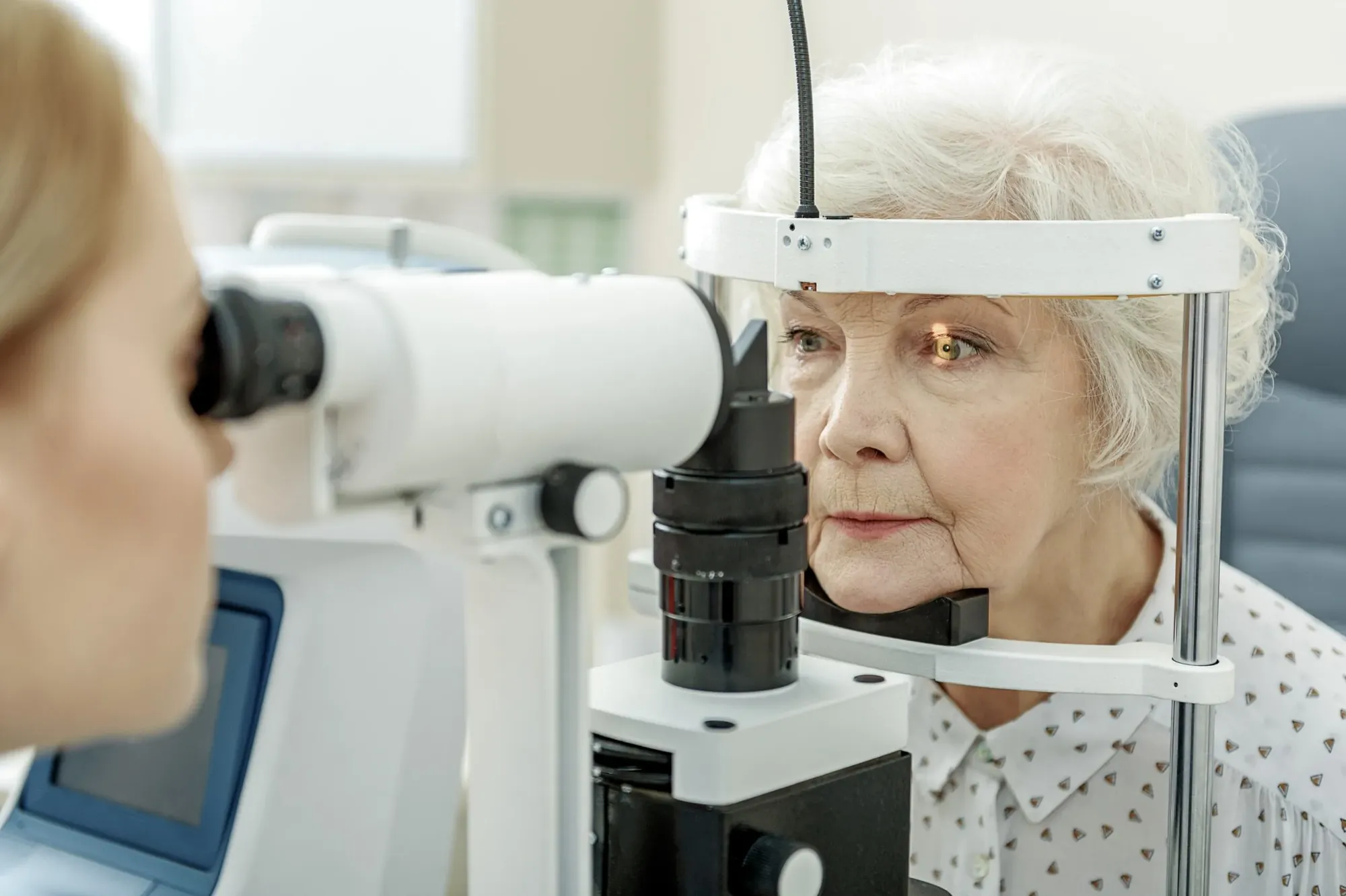
The type of glaucoma is identified at a comprehensive eye exam. Measuring pressure is not enough on its own: StatPearls notes that 40% to 50% of people with open-angle glaucoma have pressure below 22 mmHg at a single screening. Gonioscopy, in which the doctor places a special lens on the eye to look at the drainage angle, shows whether the angle is open, narrow or closed. The doctor also examines the optic nerve, scans it with optical coherence tomography (OCT) and checks side vision with a visual field test. The National Eye Institute advises a comprehensive dilated eye exam every 1 to 2 years for people at higher risk. Glaucoma can run in families, so read our guide to whether glaucoma is hereditary if a relative has it.
Netra Restoration Therapy (NRT) at Netra Eye Institute does not treat any type of glaucoma, lower eye pressure or reopen a drainage angle, and it must never replace drops, laser or surgery. Once glaucoma is medically controlled, some people still struggle with scanning, reading or getting around because of field loss that has already happened. A functional assessment can target those tasks and coordinate with low-vision care.
Learn about Netra Restoration Therapy, Netra Eye Institute’s approach and low-vision rehabilitation.
Open-angle glaucoma and angle-closure (closed-angle) glaucoma. In open-angle glaucoma the drainage angle is open but works poorly; in angle-closure glaucoma the iris blocks it. About 9 in 10 people with glaucoma in the United States have the open-angle type.
Primary open-angle glaucoma. It accounts for about 9 in 10 US cases, and worldwide about three-quarters of people with glaucoma were projected to have open-angle glaucoma in 2010.
Angle-closure glaucoma is more likely to cause blindness in each person who has it, and an acute attack is an emergency. Open-angle glaucoma is far more common and gives no warning, so it causes more blindness overall. Both can usually be controlled if they are found early.
Yes. Left untreated, it can lead to blindness, and it cannot be cured. But treatment works well, and with early detection and modern treatment, blindness has become a rare outcome. Regular eye exams are the key to finding it early.
The terms are often used to mean the same thing. Having narrow angles on its own is not glaucoma, though: if the angle is narrow but your pressure and optic nerve are normal, you are an angle-closure suspect. Your eye doctor will decide whether you need laser treatment or monitoring.
In the United States, glaucoma is usually staged as mild, moderate or severe, based mainly on the visual field test, or as indeterminate when the stage can’t be judged. There is no single universally accepted system; research systems use three to six stages.
Yes. Glaucoma can happen in one eye or both. It usually affects both eyes, often more in one than the other. Some secondary glaucomas, such as glaucoma after an eye injury, often affect only one eye.
Open-angle glaucoma is painless. An acute angle-closure attack causes intense eye pain, often with headache, nausea and vomiting, and needs emergency care.
There is no way to prevent most glaucoma, which is why eye exams matter: they find it before it affects your vision. In eyes at risk of angle closure, laser iridotomy can help prevent an attack.
Most glaucoma is open-angle glaucoma: silent, slow and found at eye exams. Angle-closure glaucoma is less common but more likely to cost sight, and a sudden attack is an emergency. Normal-tension, secondary and childhood glaucomas each have their own causes and treatments. Whatever the type, the damage can’t be undone, so the goal is to find glaucoma early and keep the pressure where your eye doctor wants it.
Medical Disclaimer: This article provides general education and is not medical advice, diagnosis or treatment. The type of glaucoma and its treatment must be determined by a licensed eye-care professional. Sudden intense eye pain, a red eye or blurred vision, especially with halos, headache, nausea or vomiting, needs emergency care right away. NRT does not treat glaucoma and must never delay or replace pressure-lowering care.