Search conditions, treatments, research reviews and articles. Press Enter to see all results, Esc to close.
Search conditions, treatments, research reviews and articles. Press Enter to see all results, Esc to close.

Blog
October 23, 2026
Keratoconus treatment has two separate jobs: stopping the cornea from getting thinner and steeper, and helping you see clearly. Glasses and contact lenses do the second job but not the first. Corneal cross-linking does the first but rarely the second. Most people need both, and the right combination depends on your age, how fast your cornea is changing and how well you see with lenses. This guide sets out the options and when each one is used.
For the condition as a whole, including symptoms, causes, who is at risk and how it is diagnosed, read our keratoconus guide.
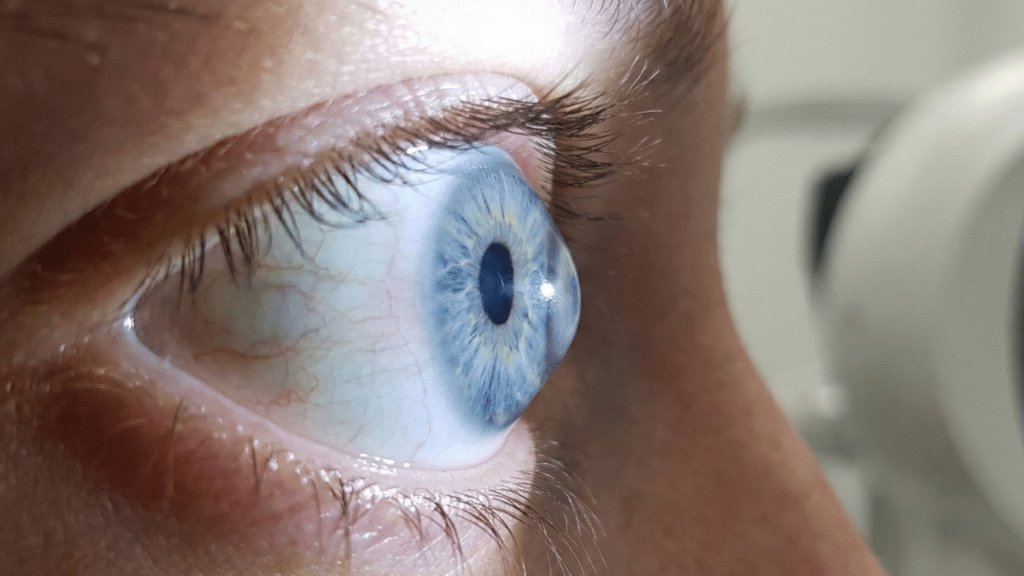
In keratoconus the cornea, the clear dome at the front of the eye, thins and bulges forward into a cone. That bulge causes nearsightedness and irregular astigmatism, which blurs and distorts vision in a way glasses cannot fully correct.
Goal one is stability. Keratoconus usually changes most in the teens and twenties and slows with age, often settling by the thirties or forties. While it is progressing, every year of change can mean more distortion and a higher chance of needing surgery later. Cross-linking is used to stop that change.
Goal two is clear vision. Even a stable cornea can be too irregular for good vision with glasses. Specialty contact lenses, and sometimes procedures that reshape or replace the cornea, are used to restore sharp sight.
Your cornea specialist will usually check for progression with corneal tomography, a scan that maps the shape and thickness of the cornea, before recommending treatment. Keep copies of your scans, because comparing them over time is how progression is confirmed.
If you see well with glasses and your scans show only early changes, the priority is confirming whether the cornea is changing. Teenagers and young adults are usually rescanned at regular intervals, often every few months at first, because keratoconus progresses fastest at younger ages. Stop rubbing your eyes and treat any eye allergy now. Avoid LASIK and similar laser vision correction, which can weaken a keratoconic cornea.
If the scans show the cornea is steepening or thinning, cross-linking is the main treatment, and earlier is better because it preserves the cornea you still have. In the KERALINK trial of young people aged 10 to 16, keratoconus progressed within 18 months in 7% of those who had cross-linking, compared with 43% of those who had glasses or lenses alone. You will still need glasses or contact lenses for clear vision afterward.
When the cornea is stable but vision with glasses is poor, specialty contact lenses are usually the next step. Many people do well with rigid gas permeable or scleral lenses. If lenses cannot be fitted or tolerated, ring segments or combined laser and cross-linking procedures may be considered in selected eyes.
Scleral lenses can often give good vision even in severe keratoconus. In a Belgian study of severe keratoconus, 40 of 51 eyes that would otherwise have needed a transplant did well with long-term scleral lens wear. A corneal transplant is used when the cornea is scarred in the center or lenses no longer give useful vision.
Occasionally a very steep cornea develops a tear in its inner layer, and fluid floods in. Vision suddenly clouds and the eye becomes watery and painful. This is called acute hydrops. It needs prompt assessment by your eye doctor, who will treat the pain and swelling; it usually clears over weeks to months, sometimes leaving a scar.
Cross-linking uses riboflavin (vitamin B2) drops and ultraviolet A light to create new bonds between the collagen fibers of the cornea, making it stiffer. It is done as an outpatient procedure under numbing drops. Epi-off treatment takes about an hour; Epioxa is shorter. Cross-linking is not done during pregnancy.
In the standard method the thin surface layer of the cornea, the epithelium, is removed so the riboflavin can soak in. The FDA approved this method, Photrexa with the KXL System, for progressive keratoconus in April 2016, for people aged 14 and over. In the US trials behind the approval, treated corneas flattened by about 1.4 to 1.7 diopters at one year, while untreated corneas steepened. In an Australian trial, untreated corneas steepened by 1.75 diopters over three years while treated corneas flattened by about 1 diopter, and a German study found corneas still flatter than before treatment ten years later.
Recovery takes a few days of discomfort while the surface heals, and vision can fluctuate for weeks. Pain or discharge that gets worse after the first few days needs urgent review, because infection is a risk while the surface is healing. A temporary haze in the cornea is common and usually fades within a year. Serious complications such as infection are uncommon. In a minority of eyes, roughly 1 in 13 in one Swiss series, keratoconus keeps progressing despite treatment, more often when the cornea was very steep to begin with. Our article on keratoconus that keeps progressing after cross-linking covers that situation.
In October 2025 the FDA approved Epioxa, the first US cross-linking treatment that leaves the corneal surface in place, for people aged 13 and over. It uses its own riboflavin drops, a shorter pulsed light treatment and goggles that supply extra oxygen. Recovery is expected to be quicker and more comfortable than with epi-off, although the two have not been compared directly, and eye pain or surface defects were still reported in some treated eyes. In two company-funded trials of 409 patients, treated corneas were about 1 diopter less steep than sham-treated corneas at 12 months. The label also advises caution after a past herpes infection of the eye. European experts still prefer epi-off for children and young people under 21 because earlier epi-on methods were less effective at halting progression in young patients. Ask your cornea specialist which method suits your age, your scans and how fast your keratoconus is changing.
Cross-linking may not be recommended, or may need a modified method, if the cornea is very thin, already centrally scarred, or has an active infection, or if the keratoconus has been stable for years. Insurance coverage varies by plan and by method, and coverage for Epioxa may be more limited than for epi-off while insurers add it, so ask your cornea specialist’s office to check before booking.
Glasses and soft toric lenses work while the cornea is only mildly irregular. As it becomes more irregular, rigid lenses usually give much better vision because the tears under the lens fill in the uneven surface.
Fitting keratoconus lenses takes skill and several visits, so it is worth seeing an optometrist who specializes in medically necessary contact lenses. Never sleep in specialty lenses unless your practitioner says it is safe, and fill scleral lenses only with sterile, preservative-free saline, never tap water. A painful red eye or light sensitivity while wearing lenses needs same-day care. Lenses do not stop keratoconus, so scans continue while you wear them.
Intracorneal ring segments, such as Intacs, are small curved inserts placed inside the cornea to flatten the cone. In the US they are allowed for keratoconus under a humanitarian device exemption for adults 21 and over who can no longer see well with lenses or glasses and whose only other option is a transplant. Case series show better vision and flatter corneas in selected eyes, although there are no randomized trials, and rings are not shown to stop progression, so they are often combined with cross-linking. Rings can occasionally move, work their way out or become infected.
Other options for selected patients include surface laser treatment combined with cross-linking, an implantable lens inside the eye once keratoconus is stable, and, for advanced disease, donor-tissue ring segments (CAIRS) or Bowman layer transplantation. Most of the evidence for these comes from case series, and they are usually reserved for people who cannot wear rigid lenses.
A transplant replaces the damaged cornea with donor tissue. Deep anterior lamellar keratoplasty (DALK) replaces the front layers and keeps your own inner layer, while penetrating keratoplasty (PK) replaces the full thickness. A Cochrane review found no clear difference in vision between them, based on very low-certainty evidence, and fewer rejection episodes with DALK. In the Australian national registry, 89% of first full-thickness transplants for keratoconus were still working after 10 years, and about half after 20 years. A transplant carries a lifelong risk of rejection: redness, light sensitivity, worse vision or pain in a transplanted eye needs same-day care. Recovery takes many months, and many people still need glasses or contact lenses afterward. Because cross-linking and modern lenses now keep more corneas stable and correctable, fewer people with keratoconus need transplants than in the past.
Controlling eye allergy and stopping eye rubbing is the first step in caring for keratoconus at every stage. Rubbing puts mechanical stress on a weak cornea. Allergy drops prescribed by your eye doctor, cool compresses and lubricating drops help with the itch that drives rubbing. In uncontrolled studies many eyes stayed stable once rubbing stopped, but this has not been tested against cross-linking, so it does not replace cross-linking when progression is confirmed.
Yes, in two senses. Specialty contact lenses are non-surgical and restore vision for most people. Cross-linking is a minimally invasive procedure rather than an operation: nothing is implanted, but the epi-off method removes the surface layer, which grows back over a few days and is uncomfortable while it heals. What does not exist is a drop, tablet or supplement proven to stop keratoconus. Several eye drops are in early clinical trials, and our article on non-surgical keratoconus treatment looks at the research on inflammation and what it may mean in future.
Not yet. Treatment can stop it getting worse and restore good vision for most people, but it does not return the cornea to normal. Cross-linking stops progression in most treated eyes, specialty lenses give sharp vision even in fairly advanced keratoconus, and a transplant is an effective fallback. Our keratoconus guide covers the outlook in more detail.
Netra Eye Institute is an acupuncture and Oriental medicine practice. Nothing we offer replaces cross-linking, specialty contact lenses or corneal surgery, and keratoconus care stays with your cornea specialist. We do not perform cross-linking or fit contact lenses. We found no published clinical trials of acupuncture, Chinese herbal medicine or Ayurveda in keratoconus.
Where we may help is alongside your specialist’s plan, for example around the itch-and-rub cycle and general eye-surface comfort, with the limits of the evidence explained before you start. Our keratoconus guide sets out what the research does and does not show, and our page on Ayurvedic care for keratoconus explains where supportive care fits.
It depends on the stage. For keratoconus that is getting worse, cross-linking is the best treatment because it is the only one shown to stop progression. For clear vision, glasses work early on, and rigid gas permeable or scleral lenses usually give the best vision as the cornea becomes more irregular.
Mostly. Many people are treated with specialty contact lenses and, if the keratoconus is progressing, cross-linking, a minimally invasive outpatient procedure. Surgery such as ring segments or a transplant is needed only by a minority.
The effect appears long-lasting. In a German study that followed treated eyes for ten years, the corneas stayed flatter than before treatment. A small minority of eyes keep progressing and may need repeat treatment or other options.
There is no minimum age for monitoring, and keratoconus tends to progress faster in children and teenagers, so treatment is considered as soon as progression is confirmed. Epi-off cross-linking is FDA-approved from age 14 and Epioxa from age 13, and specialists sometimes treat younger children when the benefit is clear.
No. LASIK removes corneal tissue and can weaken a cornea that is already weak, which is why keratoconus is a reason not to have it. In selected eyes a cornea specialist may combine a surface laser treatment with cross-linking, which is a different procedure.
Coverage varies. Many plans cover FDA-approved epi-off cross-linking and medically necessary specialty contact lenses, but rules differ by plan and method, and coverage for Epioxa is still being added by many insurers. Ask your cornea specialist’s office to check your benefits and obtain any pre-approval before treatment.
Think of keratoconus treatment as two tracks. Cross-linking protects the cornea while it is changing. Glasses, specialty lenses and, when needed, procedures or a transplant restore clear vision. Stop eye rubbing, keep your scans, and ask your cornea specialist where you are on each track.
Medical Disclaimer: This article is for general education and is not medical advice, diagnosis or treatment. Decisions about cross-linking, contact lenses and corneal surgery need an individual assessment by a cornea specialist. Sudden clouding of vision, severe pain or a red, light-sensitive eye while wearing contact lenses needs same-day care. Integrative care must never delay or replace cross-linking, specialty lenses or surgery when they are recommended.