Blog
September 15, 2026
Understanding dry eye through TCM and Netra Restoration Therapy
If you have been told that your dry eyes are caused by meibomian gland dysfunction, or MGD, you have an important piece of information. The oil-producing glands in your eyelids influence how your tears spread and remain stable. When those glands are not functioning well, the eyes can burn, feel gritty, water unexpectedly, or develop fluctuating vision. Addressing MGD can be an essential part of care.
But an important contributor is not always the complete explanation. Some people continue to struggle after their gland function improves. Others have troublesome dryness with relatively modest gland changes. Their experience raises a reasonable question: what else is happening in the tear film, ocular surface, nervous system, or wider body?
Modern dry-eye science already recognizes this complexity. The 2025 TFOS DEWS III reports describe a multifactorial disease involving disrupted tear-film and ocular-surface homeostasis. In everyday language, the eye has difficulty maintaining the stable conditions needed for comfortable, protected vision. A useful assessment therefore considers the whole system, rather than assuming that every symptom comes from one gland problem. [1, 2]
Traditional Chinese Medicine, or TCM, offers another way of organizing the person's broader symptom pattern. At Netra Eye Institute, this perspective informs Netra Restoration Therapy, an individualized integrative approach drawing on acupuncture, traditional medicine, and supportive care. Understanding its role requires two things: a clear account of the traditional framework and an honest reading of the clinical evidence.
For anyone researching dry eye alternative treatment, the most useful question is specific: which additional approach might help my particular difficulties, how will benefit be measured, and how will it fit with my existing eye care?
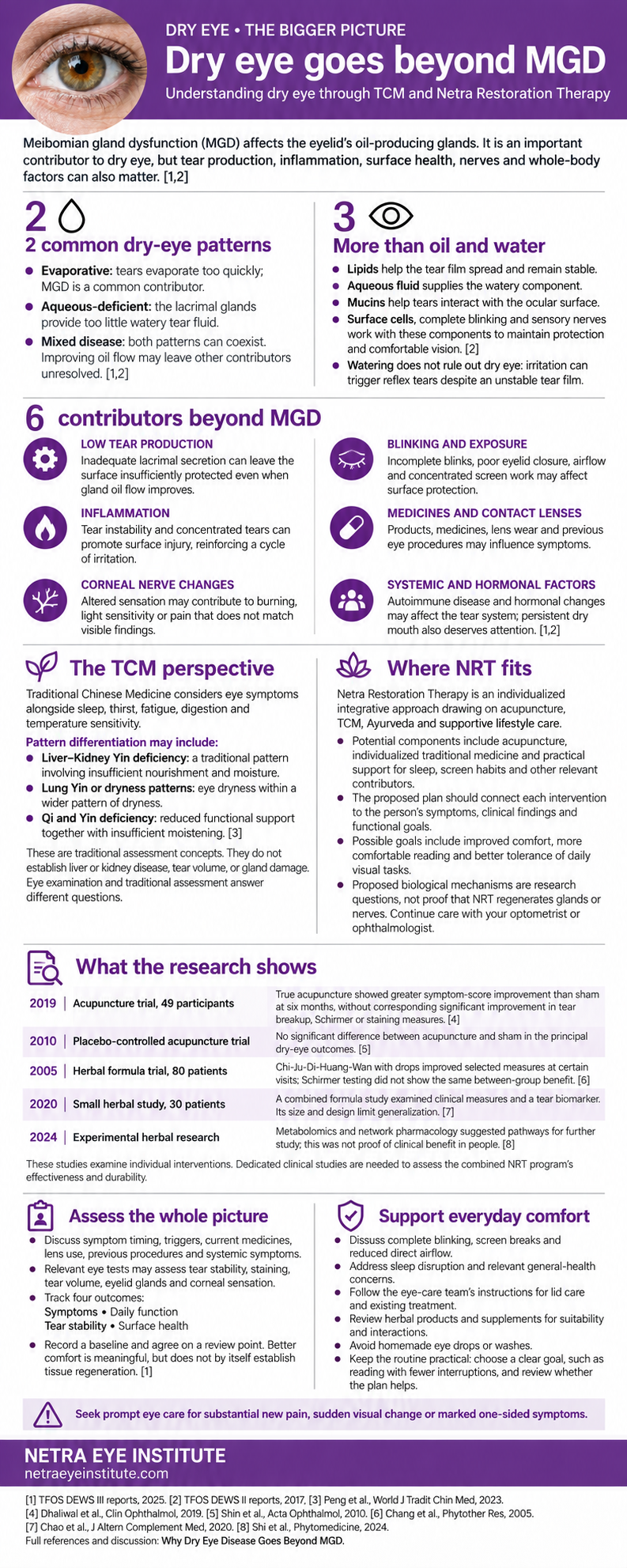
Meibomian gland dysfunction concerns abnormalities in the glands that deliver meibum, the lipid-rich secretion along the eyelid margins. Obstruction and changes in secretion can interfere with tear-film function. The international MGD workshop established a framework that includes different patterns of gland dysfunction; MGD is more than a simple yes-or-no finding of blocked openings. [3]
Dry eye disease concerns the functioning of the ocular surface and tear system as a whole. These diagnoses overlap, but they answer different questions. MGD identifies a gland-related problem. A dry-eye assessment asks whether the surface is stable, whether it is damaged, how the person feels, and which mechanisms are contributing.
Consider two hypothetical people with similar gland photographs. One has comfortable mornings and irritation after hours of computer work. The other has burning throughout the day, pronounced light sensitivity, and persistent dry mouth. The photographs might justify attention to the glands in both cases, but they do not explain why these experiences differ. The second person's additional symptoms change the questions that need to be asked.
This distinction also changes how improvement is interpreted. Better oil expression is encouraging, but it does not automatically demonstrate recovery of every part of the tear system. Similarly, continued discomfort does not establish that a gland treatment accomplished nothing. One component may have improved while another still needs attention.
Netra's guide to meibomian gland dysfunction and dry-eye testing explains why gland structure, secretion, tear measurements, and symptoms should be considered together. The broader goal is to understand the person's difficulty well enough to choose and evaluate a sensible plan.
The tear film is often illustrated as separate layers of oil, water, and mucus. That picture is useful for orientation, but the living system is more interactive. Lipids, aqueous fluid, mucins, surface cells, eyelids, and nerves work together. A problem in one part can change how the others perform. [4]
The lacrimal glands supply much of the watery component. Meibomian secretions contribute to the outer tear surface. Mucins help tears interact with the ocular surface, while the epithelial cells beneath them provide a protective, wettable interface. Blinking redistributes the film and clears debris. None of these functions is adequately described by the amount of oil alone. [4]
This explains why “my eyes make plenty of water” does not settle the diagnosis. A watering eye may still have an unstable surface. Equally, a person may have insufficient tear volume even when the eyelid glands are receiving attention. The relevant question is how effectively tears protect the eye between blinks.
Vision belongs in this discussion as well as comfort. The tear film forms part of the eye's optical surface. A patient might describe difficulty keeping text clear during a meeting, rather than simply saying that the eyes feel dry. Asking how symptoms affect a specific activity often reveals more than asking whether the eye feels better in general.
The practical implication is straightforward: a comprehensive plan should have a functional purpose. More comfortable reading, steadier vision during screen work, or fewer interruptions during driving can be meaningful goals. A single test value can inform that plan, but it should not become the entire definition of success.
Several mechanisms can maintain discomfort alongside MGD. Their relative importance differs between people and may change over time. Identifying them requires an examination and history, rather than matching one symptom to one presumed cause.
Insufficient aqueous tears. When lacrimal output is low, improving the lipid contribution may leave an important deficit unresolved. Aging, certain medicines, and medical conditions can contribute to reduced tear production. Persistent eye dryness accompanied by mouth dryness deserves particular attention because it can occur in Sjögren disease and other systemic conditions. [5]
Inflammation and epithelial injury. Tear instability can increase the concentration of dissolved substances in tears, creating hyperosmolar stress. Inflammatory signaling and damage to surface cells can then reinforce instability. The resulting cycle helps explain why simply correcting an initiating factor may not immediately normalize the entire surface. [6]
Altered corneal sensation. Corneal nerves participate in protective reflexes and transmit sensory information. Nerve injury or sensitization can contribute to burning, pain, or exaggerated responses to wind and light. Reduced sensitivity can create a different problem: substantial surface damage with unexpectedly little discomfort. Symptoms and visible findings therefore need to be interpreted together. [7]
Blinking and exposure. Incomplete blinking, incomplete eyelid closure, and environmental airflow can interfere with surface protection. A history of worsening during concentrated screen work or on waking may help guide assessment, but timing alone cannot establish the cause. [8]
Treatment and medication effects. Contact lenses, previous procedures, topical products, and systemic medicines may influence the ocular surface. The relevant question is what changed before symptoms began or worsened. A medication review belongs with the prescribing clinician; stopping a necessary medicine independently can create a different health problem. [9]
These possibilities are not competing explanations that require choosing a single winner. Someone may have MGD, low aqueous output, and exposure at the same time. Another person may have a reasonably protected surface but a substantial pain component. The plan should reflect the combination found in that individual.
Netra's article on dry-eye causes, screens, medicines, and environment provides a useful companion to this discussion. Keeping a brief record of timing, triggers, and recent changes can make the next assessment more informative.
Looking beyond MGD includes taking systemic symptoms seriously. The eye is not disconnected from hormones, immune activity, sleep, or general health. This does not mean that every patient needs extensive testing. It means that the history should determine which possibilities deserve investigation.
Sex-related biological factors and hormonal influences affect the lacrimal glands, meibomian glands, and ocular surface. The TFOS report on sex, gender, and hormones describes a complex picture rather than a single hormone deficiency that explains every case. A hormonal transition may be relevant to the history without identifying one universal treatment. [10]
Sleep is another useful example. An experimental study found that sleep deprivation reduced tear secretion and impaired tear-film measures in healthy participants. That supports attention to sleep, but it does not prove that poor sleep explains every patient's dry eye or that improving sleep alone will resolve established disease. [11]
Dry mouth, joint symptoms, unusual fatigue, or other systemic complaints should be shared with the medical team. Netra's discussion of dry eye, Sjögren disease, and systemic illness explains why those details can matter. A traditional pattern assessment should never be used to dismiss findings that warrant medical evaluation.
For the patient, this broader history can feel more representative of daily life. Eye discomfort may be one part of a difficult combination of sleep disruption, fatigue, work demands, and uncertainty. A useful consultation makes room for that experience while keeping the clinical questions clear. Listening broadly and investigating selectively are compatible goals.
Traditional Chinese Medicine organizes health through concepts such as Yin, Yang, Qi, Blood, and functional organ systems. These terms belong to a traditional interpretive framework. They should not be translated automatically into modern measurements of hormones, circulation, inflammation, or organ damage. The World Health Organization's terminology standard helps define the language; it does not establish that every traditional explanation is biologically proven. [12]
In this framework, a practitioner considers how symptoms occur together. Eye dryness may be discussed alongside thirst, sleep, fatigue, temperature sensations, digestion, and other features. Tongue and pulse findings may also inform the traditional assessment. The aim is pattern differentiation: deciding which traditional pattern best describes the presentation and how that pattern should guide care. [13]
The distinction matters when patients hear phrases such as “Liver deficiency” or “Kidney Yin deficiency.” Capitalized organ names here refer to TCM systems. They do not, by themselves, diagnose liver disease, kidney disease, abnormal laboratory results, or a failing anatomical organ. A patient should be able to ask the practitioner to explain the term without leaving with a mistaken medical diagnosis.
TCM's emphasis on the wider pattern can encourage a detailed conversation about the person experiencing dry eye. Its clinical value, however, still needs to be assessed through meaningful outcomes. An explanation that feels coherent is not the same as evidence that a particular treatment improves tear production or repairs tissue.
Netra's overview of TCM ophthalmology and Chinese herbal medicine introduces this treatment tradition. For dry-eye care, the most useful approach is to keep both descriptions visible: the measured ocular findings and the traditional pattern used to guide adjunctive treatment.
The Liver–eye relationship is one of the better-known ideas in TCM. Traditional teaching associates the Liver system with the eyes and with the nourishment attributed to Blood. Kidney-related concepts may also appear in discussions of chronic dryness and constitutional patterns. These relationships explain the language of traditional treatment; they are not proof that an uncomfortable eye is caused by anatomical liver or kidney dysfunction. [13]
This is especially important for readers searching for the Chinese medicine liver-eye connection. A TCM practitioner may use that framework to organize a symptom history, but an eye examination still answers different questions: whether the cornea is injured, whether the tear film breaks up quickly, and whether there is another condition requiring attention.
The two descriptions can be discussed without claiming that they are interchangeable. For example, “nourishing Liver Blood” is a traditional therapeutic intention. It should not be presented as a measured increase in ocular blood flow unless a suitable study actually demonstrates that outcome. Likewise, “nourishing Yin” should not be relabeled as proven gland regeneration.
A clear consultation makes these distinctions understandable. Patients should know which statements describe traditional theory, which describe a proposed mechanism, and which are supported by clinical measurements. That clarity allows the traditional perspective to be considered on its own terms while preserving the precision needed for eye care.
Traditional dry-eye guidelines describe patterns involving Yin deficiency, dryness, heat, and other combinations of findings. Different practitioners and systems may use somewhat different classifications. These descriptions are tools within TCM practice, rather than self-diagnosis checklists or validated substitutes for ocular-surface testing. [14]
Liver–Kidney Yin deficiency may be considered when chronic eye dryness occurs within a broader pattern interpreted as insufficient nourishment and moisture. The practitioner looks for accompanying features rather than assigning the pattern simply because the eyes feel dry. A TCM pattern does not establish the level of lacrimal secretion or the condition of the meibomian glands. [14]
Lung Yin deficiency or dryness-related patterns place eye symptoms within a wider traditional account of dryness. Qi and Yin deficiency combines concepts of reduced functional support and insufficient moistening. These labels may guide different traditional treatment choices even when two patients share the biomedical diagnosis of dry eye. [14]
Other TCM assessments may discuss Blood deficiency, stagnation, or digestive patterns. The useful question is how the practitioner reached that interpretation and what practical difference it makes. If the same formula or treatment course is offered regardless of the history, describing the care as individualized requires further explanation.
A 2026 cross-sectional study examined TCM patterns and dry-eye findings in 205 participants. It reported associations between traditional pattern features and aspects of dry eye. Such work can help generate research questions, but an association does not demonstrate causation or prove that treating a pattern improves the ocular surface. [15]
The distinction between describing a population and predicting treatment response is crucial. A pattern might occur frequently among people with dry eye without identifying which therapy will help them. To test that question, researchers would need to compare outcomes prospectively, define the pattern consistently, and account for differences between groups. A pattern associated with more severe symptoms might also reflect illness burden rather than a distinct causal pathway. These are research questions that deserve investigation. They should not be converted into certainty at the first consultation or used to suggest that every patient with a particular traditional label will respond alike.
For a patient, a sound explanation would connect the traditional assessment to a proposed plan and a measurable goal. “We are using this pattern to guide an adjunctive approach and will review your comfort and eye findings” is more informative than an assurance that a hidden imbalance has been identified with certainty.
Traditional terminology should also remain open to reassessment. If the clinical picture changes, the practitioner should reconsider the plan. Pattern differentiation is most useful when it supports careful observation, rather than becoming a label that explains every new symptom without further investigation.
Imagine a patient whose main difficulty is late-afternoon burning during long workdays. The eye examination identifies MGD and rapid tear breakup. The patient also describes short sleep, skipped breaks, and an increasingly demanding schedule. A practical plan can address the measured gland problem and the daily circumstances that make symptoms difficult to manage.
Now imagine a second patient with persistent dryness, mouth discomfort, fatigue, and symptoms throughout the day. That history calls for consideration of systemic disease. A TCM assessment may still be part of the person's care, but it should run alongside the appropriate medical investigation. The broader symptom pattern is a reason to ask better questions, not a reason to assume the cause has already been found.
A third patient describes severe burning and light sensitivity despite limited visible staining. That mismatch deserves attention to pain and sensation. The person should not be told that the symptoms are imaginary because the eye looks relatively quiet. Equally, the symptoms alone do not prove a particular nerve disorder.
These are illustrative scenarios, not reports of Netra treatment outcomes. Their purpose is to show why the same dry-eye label can lead to different assessments. A whole-person approach becomes clinically useful when it changes the questions asked, identifies relevant problems, and produces a plan that can be evaluated.
Netra's dry-eye treatment page describes NRT as an adjunctive whole-person program, with attention to ocular comfort, inflammatory balance, autonomic regulation, and systemic contributors. The broader NRT model draws on acupuncture, TCM, Ayurveda, and supportive lifestyle care. The combination selected for an individual should depend on the assessment and treatment goals.
For dry eye, this means NRT can be discussed as an additional approach within a coordinated care plan. It should begin with the person's actual difficulties: persistent discomfort, limited screen tolerance, sleep-related challenges, or concerns about the wider symptom pattern. “Treating the whole person” becomes useful when it leads to concrete questions and decisions.
An individualized discussion should explain what is being proposed, why it is relevant, and how its value will be judged. A patient might ask whether acupuncture is intended primarily to support comfort, whether a herbal formula is being considered, and what evidence applies to those choices. The answers should distinguish an intended effect from an established result.
The word “restoration” also deserves a practical definition. For a patient, a meaningful improvement might be reading comfortably for longer or experiencing fewer disruptive episodes of burning. Those outcomes matter. They do not, on their own, prove that missing meibomian glands have regrown, corneal nerves have regenerated, or an autoimmune process has been reversed.
The clinical studies discussed below investigate particular acupuncture protocols or herbal interventions. They do not establish the effectiveness of Netra's complete combined NRT program for dry eye. Evidence for one component can support a discussion, but it cannot automatically be transferred to every combination, dose, schedule, or patient group.
This distinction helps patients make informed choices without dismissing their interest in integrative care. The relevant question is whether a carefully selected adjunct provides worthwhile benefit for that person, with appropriate follow-up and continued attention to ocular health.
Coordination also matters in ordinary practical ways. The person providing adjunctive care should know which treatments the eye-care team has recommended and which concerns remain under investigation. The eye-care team should know about herbal products and other interventions being used. A shared account of the plan can reduce confusion when symptoms change. It also makes it easier to decide who will assess a new complaint, who will interpret repeat eye measurements, and who will review the adjunctive component. Patients should not have to reconcile conflicting explanations on their own or guess whether advice from one appointment overrides the plan from another.
Dry-eye discussions often include inflammation, nerve signaling, oxidative stress, autonomic activity, and tissue resilience. These are meaningful areas of biological research. They are also easy to turn into overly broad promises if the relationship between mechanism and clinical outcome is not explained.
Take inflammation as an example. It participates in the dry-eye cycle, but an intervention described as “anti-inflammatory” has not necessarily been shown to improve dry-eye symptoms in people. The relevant evidence would need to identify the intervention, the population, the comparison group, and the outcomes measured. A laboratory effect is one stage of that investigation. [6]
The same reasoning applies to nerve function. Corneal sensory pathways contribute to tear and blink responses and to ocular pain. That makes them relevant to a comprehensive model, but it does not show that a particular acupuncture or herbal protocol repairs human corneal nerves. Improvement in a symptom questionnaire and structural nerve recovery are different findings. [7]
Autonomic regulation is sometimes proposed as part of the rationale for acupuncture. A patient may find the treatment setting relaxing, yet relaxation alone does not demonstrate normalization of tear secretion. A convincing explanation should state whether the intended benefit concerns stress, perceived discomfort, a tear measurement, or another defined outcome.
Likewise, mitochondrial or antioxidant terminology should not be used as a shortcut to a clinical claim. An experimental finding may justify further research while leaving important questions unanswered about dosage, safety, durability, and real-world function. A proposed pathway is best presented as a hypothesis until patient studies establish the relevant benefit.
For people whose symptoms suggest a sensory component, Netra's information on corneal neuropathy offers a related topic to discuss with their eye-care team. The purpose of considering nerves is to improve assessment and care, rather than to attach a new explanation to every difficult case of dry eye.
Acupuncture for dry eyes has been studied in randomized trials, but the findings are not uniform. Differences in needling protocols, comparison treatments, participant selection, and outcome measures make simple statements such as “acupuncture works” or “acupuncture does not work” less informative than examining the actual studies.
A 2019 randomized trial compared true and sham acupuncture in 49 participants. It reported a greater improvement in the Ocular Surface Disease Index in the true-acupuncture group at six months. However, the study did not find corresponding significant improvements in the reported tear breakup, Schirmer, or staining measures. The result supports interest in symptom benefit while leaving questions about objective surface changes. [16]
A 2010 randomized placebo-controlled trial did not find a significant difference between acupuncture and sham acupuncture in its principal dry-eye outcomes. This is an important counterpoint. A balanced account should include less favorable findings, particularly when a treatment is being considered for a condition with fluctuating symptoms and substantial expectations around care. [17]
These studies also illustrate why a sham comparison matters. Time, attention, expectations, natural symptom variation, and other care can affect how people feel. Improvement from baseline is encouraging for the patient, but a comparison group helps determine how much improvement can reasonably be attributed to the tested intervention.
For NRT, the practical implication is to describe acupuncture as a possible adjunct with uncertain individual benefit. The research does not support promising that it will reopen every gland, restore every tear measurement, or permanently eliminate the need for other care. A trial of treatment should have a defined purpose and a review point.
Patients can read Netra's discussion of acupuncture for eye disease and the evidence for the broader context. During a consultation, useful questions include which outcomes are expected to change, how soon they will be reviewed, and what would justify modifying or stopping the approach.
This is a more informative way to discuss natural therapy for dry eyes than treating “natural” as a guarantee. The patient's experience matters, and so does the quality of the evidence used to interpret it.
A useful research summary answers more than whether a result was statistically significant. How large was the improvement? Did it change an activity that matters to patients? Were participants similar to the person considering treatment? A trial involving one dry-eye presentation may offer limited guidance for someone with a different combination of surface disease, systemic illness, and pain.
Duration matters too. A response recorded soon after treatment does not establish that it persists months later. Conversely, a longer follow-up finding needs to be interpreted alongside any changes in other care during that interval. The best evidence makes those details visible rather than reducing the study to a favorable headline.
Safety reporting belongs in the same assessment. A small study may be unable to detect uncommon adverse effects, and a short study cannot answer every long-term question. Absence of a reported problem is therefore different from proof that a treatment has no risk. The decision should consider likely benefit, uncertainty, treatment burden, and suitability together.
These questions are especially helpful when evaluating a combined program such as NRT. Evidence about a component can inform a discussion, while the combined program still needs its own clearly defined outcomes and careful follow-up. Patients are entitled to know where the evidence ends and individualized clinical judgment begins.
Chinese herbal medicine is another potential component of individualized TCM care. Research includes studies of specific formulas, combinations, and experimental models. Those findings should be tied to the preparation actually studied; one formula's results cannot establish that all herbal products are effective for dry eye.
A 2005 randomized study of 80 patients evaluated Chi-Ju-Di-Huang-Wan alongside eye drops, compared with drops and placebo. Selected measures, including staining and tear breakup at particular follow-up points, favored the herbal group, while Schirmer testing did not show the same between-group benefit. The study offers a signal for further investigation, rather than proof of a universal dry-eye remedy. [18]
A small study published in 2020 investigated Chi-Ju-Di-Huang-Wan combined with Si Wu Tang and lubricating drops. It included 30 patients and examined clinical measures and tear vascular endothelial growth factor. Its size and design limit how confidently the findings can be generalized. A change in a tear biomarker does not independently prove improved ocular circulation or tissue regeneration. [19]
A 2024 study used metabolomics, network pharmacology, and an experimental model to investigate QiJu-DiHuang Wan in age-related dry eye. Such research can suggest pathways worth studying. It cannot establish the same clinical effect, appropriate dose, or long-term safety in a person seeking care. [20]
For someone considering herbal treatment within NRT, product identity and oversight matter. The consultation should address the complete ingredient list, other medicines and supplements, allergies, pregnancy where relevant, and medical conditions that may affect suitability. NCCIH notes concerns including contamination, substitution, and adverse effects with some traditional products. “Herbal” is not a sufficient description of either quality or safety. [21]
These studies concern defined interventions, not instructions for home experimentation. Oral formulas should not be turned into homemade eye drops or washes. Anything placed directly on the eye needs appropriate ocular safety and sterility; teas, kitchen oils, and supplements are not interchangeable with products intended for ophthalmic use.
The most useful conversation is individualized and specific: which formula is proposed, what is the rationale, what is known about it, and what will be monitored? If those questions cannot be answered clearly, the uncertainty should remain visible rather than being concealed by broad claims about tradition.
Although this article focuses on TCM, Netra's wider treatment model also includes Ayurveda. These are distinct traditions with their own terminology and assessment methods. A patient should not have to assume that a TCM pattern and an Ayurvedic explanation are identical simply because both appear within one integrative program.
The Netra treatment overview describes a range of modalities across these systems. Their inclusion on a general treatment page does not establish that each is appropriate for every dry-eye patient or that all are included in an individual course. The proposed plan should identify the actual components being considered.
Readers sometimes search for “dry eye treatment in Ayurveda” or ask whether an Ayurvedic approach can provide a permanent cure. A careful answer begins with the person's diagnosis and the specific intervention. The acupuncture and Chinese-formula trials cited in this article do not validate a different Ayurvedic preparation or procedure.
This keeps the NRT discussion coherent. Traditional perspectives can contribute to an individualized conversation, while decisions about eye-contact procedures, product quality, and suitability require particular care. There is no need to turn an interest in integrative treatment into a universal treatment package or a promise of complete recovery.
Before adding an intervention, it helps to know what problem the plan is intended to address. A comprehensive dry-eye assessment may include symptom questionnaires, slit-lamp examination, tear stability, surface staining, tear-volume assessment, eyelid examination, and consideration of sensation or systemic disease where indicated. No single test captures the full experience. [22]
The patient can contribute useful information before the visit. A brief account of when symptoms began, which eye is affected, what makes symptoms worse, and how daily activities have changed is often more useful than a long list of products tried without dates or outcomes. Bring the names of current drops, supplements, medicines, and lid-care products.
For an NRT consultation, existing reports can help keep the discussion grounded. A diagnosis of MGD, a history of surgery, or concern about a systemic condition should be part of the conversation. This does not imply that every specialized test is performed at Netra; appropriate testing and medical interpretation may remain with the treating optometrist or ophthalmologist.
The resulting plan should be understandable in ordinary language. Which contributors are reasonably established? Which remain uncertain? What is the proposed adjunct intended to improve? What would trigger referral or reassessment? A patient should leave knowing more than the name of a treatment course.
One useful preparation is to choose a specific daily-life goal. “I want to finish a reading session with fewer interruptions from burning” gives the team something practical to track. It also makes the conversation about benefit more meaningful than relying on a general impression that the eyes seem better.
Patients researching natural dry-eye care often encounter long routines involving food restrictions, supplements, compresses, special glasses, and repeated exercises. A routine becomes less useful when it is too burdensome to follow or when every step is introduced at once. Supportive care should be proportionate to the person's findings and daily life.
For someone whose symptoms build during concentrated screen work, discussing blinking, breaks, workspace airflow, and visual demands can be worthwhile. The goal is a sustainable adjustment that can be evaluated. A complicated schedule is not automatically more therapeutic than a small number of practical changes chosen for a clear reason. [8]
Sleep deserves similar attention. If a person reports ongoing sleep disruption, that concern should be addressed for general health as well as its possible relationship with eye symptoms. The sleep-deprivation study supports taking the issue seriously, but it does not justify telling patients that failure to sleep well is their fault or the sole cause of their condition. [11]
Nutrition and supplements also need measured language. In the large DREAM randomized trial, patients receiving 3,000 mg daily of fish-derived omega-3 fatty acids did not achieve significantly better dry-eye outcomes than those receiving the study's olive-oil placebo over 12 months. This finding does not answer every dietary question, but it argues against promising that routine high-dose omega-3 supplementation will reliably resolve dry eye. [23]
Netra's guide to natural dry-eye care, nutrition, and hydration explores those topics in more detail. For this article's purpose, the central point is that lifestyle support belongs within a reasoned plan. It should not become an ever-expanding list of things the patient must do before their persistent symptoms are taken seriously.
Any adjunctive treatment becomes easier to evaluate when the starting point is recorded. That might include a symptom score, the activities most affected, current care, and relevant ocular findings from the eye-care team. Without a baseline, it is difficult to distinguish a meaningful improvement from a good day in a fluctuating condition.
A short diary can keep this manageable. Record one or two activities that matter, a simple description of discomfort, and unusual circumstances such as travel or an exceptionally long workday. There is little value in monitoring so many details that the record becomes another source of stress. The aim is to make a pattern easier to discuss. For example, fewer interruptions during a comparable reading session may be more informative than comparing a quiet weekend with a demanding day in an air-conditioned office. Bring the record to the agreed review and use it alongside, rather than in place of, the clinical assessment.
Agreeing on a review point is equally useful. The interval should reflect the proposed intervention and clinical circumstances rather than a universal promise. At review, the discussion should consider whether the original goal changed, whether improvement lasted between visits, whether adverse effects occurred, and whether the treatment burden remains reasonable.
Different outcomes answer different questions. Better comfort can be valuable even if a tear test changes little. Improved staining can be important even if the patient still struggles with pain. Neither result should be exaggerated into an outcome that was not measured. The point of follow-up is to understand the response accurately enough to make the next decision.
When several interventions begin together, attributing benefit to one component becomes difficult. Sometimes combined care is appropriate, but the uncertainty should be acknowledged. A patient who improves during NRT may also have changed screen habits, sleep, or other treatment. Their improvement remains real; the explanation may be less certain.
Continued care should therefore depend on the overall value to the patient. If the expected benefit is absent, the plan deserves reconsideration. An individualized approach includes the ability to change direction, seek another assessment, or decide that a particular adjunct is not worthwhile.
Can I have dry eye without significant MGD? Yes. Reduced aqueous production and other ocular-surface problems can contribute independently or alongside gland dysfunction. The examination should establish which findings are present rather than treating MGD as a required explanation for every dry-eye complaint. [1]
Why are my eyes watery if they feel dry? An irritated surface can trigger reflex tearing, while the underlying tear film remains unstable. Overflowing tears therefore do not establish that the surface is adequately protected. Netra's dry-eye questions and watery-eye guide discusses this common source of confusion.
Does TCM say dry eye means I have liver disease? No. The TCM Liver system is a traditional concept and should not be equated with a diagnosis involving the anatomical liver. Medical symptoms or abnormal laboratory findings require their own interpretation. [12, 13]
Can acupuncture replace my current eye care? The studies described here do not support that conclusion. Acupuncture may be considered as an adjunct for selected patients, with expectations based on the limited and mixed evidence. Changes to prescribed care should be discussed with the treating clinician. [16, 17]
Can NRT regrow meibomian glands or repair corneal nerves? The cited acupuncture and herbal studies do not establish those outcomes for the combined NRT program. Symptom improvement, tear stability, gland structure, and nerve structure are separate endpoints. Any regeneration claim requires evidence that directly measures the relevant tissue change.
Is there a permanent natural cure for dry eyes? There is no single intervention that can reasonably be promised to cure every form of dry eye permanently. A more useful goal is to identify active contributors, improve daily function, and establish a manageable plan. The expected course depends on the underlying condition and the individual's response.
How many NRT sessions will I need? A reliable universal number cannot be derived from the studies discussed here. Ask for the proposed schedule, the reason for it, a review point, and the criteria for continuing. An individualized recommendation should explain uncertainty rather than replace it with a guaranteed timetable.
When should I seek prompt eye care? A marked new change, substantial pain, or reduced vision should not be assumed to be routine dry eye. Seek timely assessment by an eye-care professional, particularly when symptoms are sudden or affect one eye much more than the other. An integrative appointment should not delay evaluation of a potentially urgent eye problem.
Looking beyond MGD means taking the diagnosis seriously enough to ask what it explains and what it leaves unresolved. The glands matter, but so do tear production, surface integrity, sensation, exposure, systemic health, and the practical demands of daily life. A complete picture is more useful than a single explanation repeated after the symptoms have changed.
TCM can contribute a structured traditional perspective on the broader symptom pattern. NRT brings that perspective into an individualized integrative discussion. Its value for a particular patient should be judged through clear goals, appropriate oversight, and an honest account of what the available evidence supports.
If you are considering an alternative treatment for dry eyes, bring your existing diagnosis, current care plan, and most important functional concerns to the conversation. Ask what the proposed approach is intended to change and how that change will be assessed. Those questions help turn a broad interest in holistic care into a decision that is specific to you.
To explore whether an adjunctive approach fits your situation, request a consultation with Netra Eye Institute. A useful starting point is a clear description of what your eyes are preventing you from doing comfortably and what you hope care will help you regain.