Clinical guide
How anterior basement membrane dystrophy causes erosions, dryness, and pain, and how NRT may complement conventional corneal care while the ophthalmologist manages the underlying structural abnormality.
September 1, 2026
Map-dot-fingerprint dystrophy, also called anterior basement membrane dystrophy, is a common corneal surface condition in which the epithelium does not anchor properly. Many people never notice it; others get recurrent erosions — sharp pain on waking, blurring and watering. This page covers how it is diagnosed and how erosions are prevented.
How NRT may complement care for erosions, dryness, inflammation, and pain in Anterior Basement Membrane Dystrophy.
By Saikumar Gandapodi DAOM, L.Ac., Dipl. OM and Ahmad Nasir MBBS, DOM (Ophthalmology).
Printable edition. This article is also available as a designed one-page PDF: Comanaging ABMD: Integrating Corneal Care with NRT (PDF).
Netra Restoration Therapy (NRT) may be incorporated into a comanagement plan as an adjunct to conventional corneal care to support tear-film stability, promote a healthier epithelial-healing environment, reduce associated ocular-surface inflammation, and address secondary corneal nerve sensitization, while the ophthalmologist manages the underlying structural abnormality and recurrent erosions.
In anterior basement membrane dystrophy (ABMD), the epithelial basement membrane becomes irregular, thickened, or multilayered. Basal epithelial cells may not anchor normally through hemidesmosomes and anchoring fibrils. The resulting uneven surface can cause fluctuating or blurred vision, glare, dryness, foreign-body sensation, and painful recurrent corneal erosions. Symptoms often occur during the night or when the eyelids first open in the morning.
The basement-membrane abnormality is the starting problem, but the surrounding ocular environment can influence its severity. Tear-film instability increases eyelid friction. An erosion then activates wound-healing signals, inflammatory mediators, and matrix metalloproteinases such as MMP-9. Excessive protease activity may weaken adhesion structures and interfere with stable re-epithelialization. Repeated injury can also sensitize exposed corneal nerves, allowing pain to persist beyond visible surface damage.
NRT is intended to complement the patient's corneal treatment plan by addressing modifiable factors around the structural disorder. Depending on the individual evaluation, supportive goals may include:
A meaningful adjunctive benefit would not require disappearance of the map-dot-fingerprint pattern. It would be reflected in fewer or less severe morning erosions, more stable comfort between episodes, improved tear-film findings, reduced corneal staining, and better visual consistency, improved visual acuity and overall quality of life.
Research supports the importance of tear-film quality, epithelial adhesion, inflammatory signaling, MMP activity, and corneal nerve health in recurrent erosion. Small dry-eye studies have reported changes in tear secretion, tear-film breakup time, and inflammatory markers after acupuncture and herbal medicine. However, no clinical trials have shown that NRT can remove ABMD or rebuild a normal basement membrane.
NRT will be integrated with established corneal care. Depending on severity, conventional management may include preservative-free lubrication, nighttime ointment or hypertonic saline, treatment of blepharitis or meibomian gland dysfunction, a supervised bandage contact lens, anti-inflammatory or MMP-modulating therapy, and procedures such as diamond-burr polishing, superficial keratectomy, or phototherapeutic keratectomy. Sudden severe pain, marked redness, discharge, light sensitivity, or reduced vision requires prompt ophthalmic evaluation.
Useful follow-up measures may include the number and duration of erosion episodes, morning pain severity, Ocular Surface Disease Index score, tear-film breakup time, corneal staining, MMP-9 when available, corneal topography or keratometry, uncorrected and best-corrected visual acuity, refractive stability, contrast sensitivity, and glare testing. Color-vision and visual-field testing may be added when clinically indicated by a coexisting retinal, macular, or optic-nerve condition.
The appropriate goal is to improve the environment around ABMD. NRT does not eliminate the underlying basement-membrane abnormality.
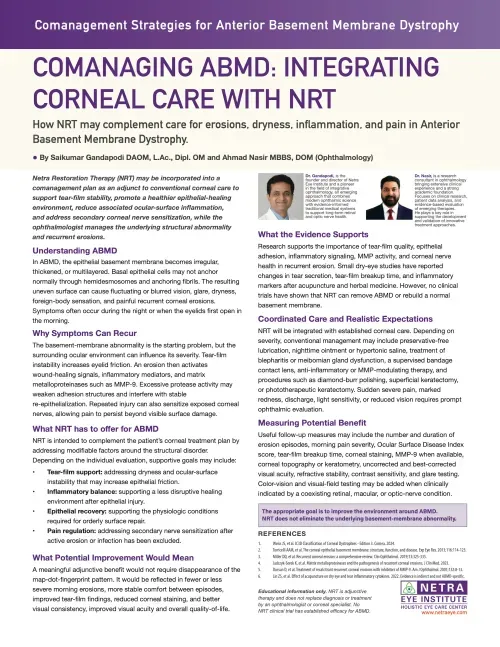
Download: Comanaging ABMD — Integrating Corneal Care with NRT (PDF)
Educational information only. NRT is adjunctive therapy and does not replace diagnosis or treatment by an ophthalmologist or corneal specialist. No NRT clinical trial has established efficacy for ABMD.