Clinical guide
How ABCA4-related Stargardt disease damages central vision, what multimodal diagnosis involves, and where Netra Restoration Therapy fits as adjunctive supportive care in a comanagement plan.
September 1, 2026
An integrative perspective on inherited macular degeneration and coordinated supportive care.
By Saikumar Gandapodi DAOM, L.Ac., Dipl. OM and Ahmad Nasir MBBS, DOM (Ophthalmology).
Printable edition. This article is also available as a designed one-page PDF: Stargardt Disease: Mechanisms, Function, and NRT Support (PDF).
Stargardt disease is an inherited retinal disorder that primarily damages central vision. It often begins in childhood or young adulthood, but onset and progression vary widely. Netra Restoration Therapy (NRT) may be incorporated into a comanagement plan as adjunctive treatment which is aimed to target the pathological pathways of inherited retinal disorders, thereby slow down progression and enhance residual vision.
Most cases are caused by disease-causing variants in both copies of ABCA4. The ABCA4 protein helps photoreceptors clear vitamin A-derived molecules made during the visual cycle. Reduced function permits toxic bisretinoids to accumulate as lipofuscin in the retinal pigment epithelium. Retinal pigment epithelial dysfunction and photoreceptor loss then produce progressive macular atrophy and central visual impairment.
Blurred or missing central vision, difficulty reading or recognizing faces, glare or photophobia, reduced color discrimination, and slow adaptation between bright and dim environments are common. Peripheral vision is often preserved, so many people remain independently mobile even when detail vision is significantly affected. Symptoms can precede classic retinal findings.
A retina or inherited-retinal-disease specialist integrates history, visual acuity, color and field testing, dilated examination, optical coherence tomography (OCT), and fundus autofluorescence (FAF). Electroretinography may assess broader retinal function. Genetic testing with counseling can confirm ABCA4-related disease, clarify inheritance, and help identify research options; inconclusive testing does not always exclude the diagnosis.
NRT may help address the following for Stargardt disease.
No approved therapy currently reverses Stargardt disease. NRT focuses on improving the metabolic health of the retinal environment by addressing downstream stress across several interacting pathways associated with inherited retinal degeneration. Care should also include refractive correction, periodic retinal monitoring, early low-vision rehabilitation, accessible technology, and school or workplace accommodations. Avoid smoking. Patients should not self-prescribe supplements without clinician or dietitian guidance.
Track best-corrected visual acuity, OCT, FAF atrophy area, visual fields or microperimetry when appropriate, and patient-centered outcomes such as reading speed, glare, contrast, device use, school or work participation, mobility, and quality of life. Supportive improvements must not be interpreted as proof that retinal degeneration has slowed. The care team may include a retina or inherited-retinal-disease specialist, genetic counselor, low-vision specialist, education or vocational team, primary care, and mental-health support.
The therapeutic target is not retinal restoration. It is coordinated care that provides resilience, maximizes usable vision and prepares patients to evaluate future therapies responsibly.
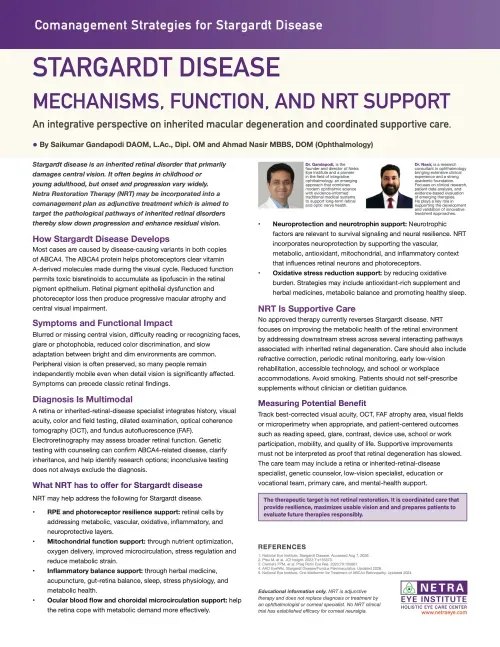
Download: Stargardt Disease — Mechanisms, Function, and NRT Support (PDF)
Educational information only. NRT is adjunctive therapy and does not replace diagnosis or treatment by an ophthalmologist or retinal specialist. No NRT clinical trial has established efficacy for Stargardt disease.