
Clinical guide
Why neuropathic corneal pain can be severe even when the eye looks quiet, how it is diagnosed, and where Netra Restoration Therapy fits as adjunctive support alongside corneal, neurologic, and pain care.
September 1, 2026
An integrative perspective on corneal nerve dysfunction and supportive NRT care.
By Saikumar Gandapodi DAOM, L.Ac., Dipl. OM and Ahmad Nasir MBBS, DOM (Ophthalmology).
Printable edition. This article is also available as a designed one-page PDF: Corneal Neuralgia: Mechanisms and NRT Support (PDF).
Corneal neuralgia, also called neuropathic corneal pain, results from dysfunction in corneal sensory pathways. Burning, aching, photophobia, or wind sensitivity may be severe even when visual acuity is excellent and surface findings are limited. Netra Restoration Therapy (NRT) may be incorporated into a comanagement plan as adjunctive support alongside appropriate corneal, neurologic, and pain evaluation and treatment.
Dry eye, infection, trauma, recurrent erosion, contact-lens injury, toxic exposure, surgery including LASIK, and systemic small-fiber neuropathy can disturb corneal nerves. Repeated epithelial stress may sustain nociceptive input, while injured fibers may develop abnormal sprouts, altered ion channels, or ectopic firing. Dry eye, neurotrophic keratopathy, recurrent erosion, and neuropathic pain can overlap, but they are not interchangeable diagnoses.
Tear instability and epithelial stress activate keratocytes, immune cells, cytokines, proteases, and neuromediators. These signals can lower sensory thresholds. Peripheral sensitization may then produce hyperalgesia or allodynia to light, air, touch, or temperature. Persistent trigeminal input may promote central or nociplastic amplification, allowing symptoms to continue after the surface has improved. No single biomarker confirms corneal neuralgia.
Corneal neuralgia may follow ocular-surface disease, infection, trauma, epithelial injury, surgery, or systemic neuropathy. Migraine, fibromyalgia or other overlapping pain syndromes, autoimmune or metabolic disease, sleep disturbance, anxiety, depression, and chronic pain history may increase vulnerability or amplify disability. Ocular surgery is one of several possible initiating events, but it does not define the condition. These are associations, not proof of causation.
NRT may help address the following for corneal neuralgia.
Examination by your ophthalmologist should assess tear breakup, staining, lid and meibomian disease, corneal sensitivity, and neurotrophic change. A topical anesthetic challenge may suggest a predominantly peripheral component when pain improves, or central contribution when pain persists; it is not definitive. In vivo confocal microscopy may show reduced or abnormal nerves, microneuromas, or increased dendritic cells; findings must be interpreted with the history and examination.
A corneal specialist should exclude infection, exposure, recurrent erosion, ectasia, herpetic disease, and neurotrophic keratopathy. Care may include preservative-free lubricants, meibomian treatment, anti-inflammatory therapy, autologous serum or platelet-rich plasma tears, scleral or PROSE lenses, and neuropathic-pain medication. Neurology, pain medicine, or behavioral health may help when central sensitization, migraine, sleep disturbance, or impaired function is prominent.
Track pain intensity and frequency, burning, photophobia, wind sensitivity, sleep and daily function, rescue medication use, OPAS or NPSI-Eye, and OSDI or SPEED. Pair symptoms with visual acuity, tear breakup time, staining, Schirmer or osmolarity when indicated, meibomian findings, corneal esthesiometry, and — when available — confocal nerve and dendritic-cell features. Normal acuity does not invalidate severe neuropathic pain.
The therapeutic target for NRT is not pain alone: it is the combination of ocular-surface health, neuro-sensory regulation, function, and quality of life.
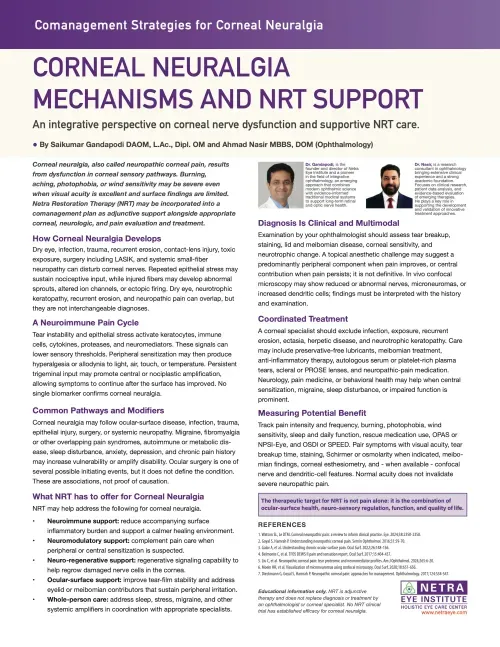
Download: Corneal Neuralgia — Mechanisms and NRT Support (PDF)
Educational information only. NRT is adjunctive therapy and does not replace diagnosis or treatment by an ophthalmologist or corneal specialist. No NRT clinical trial has established efficacy for corneal neuralgia.